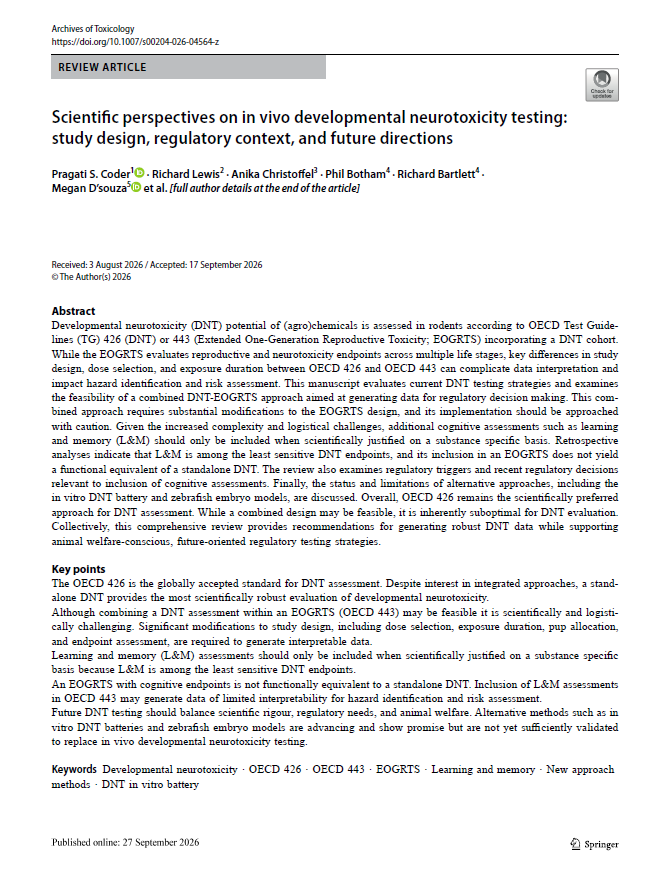
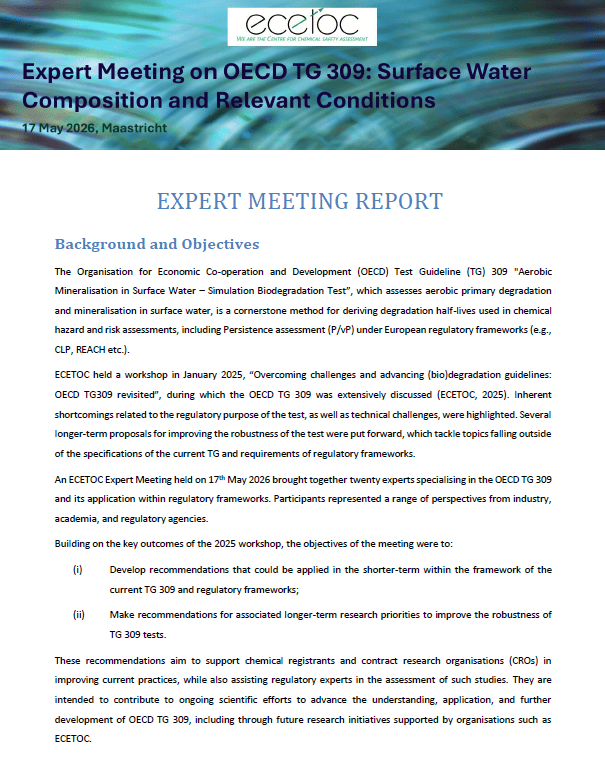







2025 Annual Report
Annual Report
ECETOC publishes a framework for the risk assessment of plastic additives
Press Release

ECETOC publishes a framework for the risk assessment of plastic additives

Part 1 sets out the fundamental elements, from problem formulation to risk characterisation.Brussels, 22 July 2026. The ECETOC Plastic Additives Task Force has published the first of two peer...
January 2026 news from the Sec Gen
News

January 2026 news from the Sec Gen

Dear colleagues and friends,As we begin a new year, I would like to thank you for your continued engagement and trust in ECETOC. 2026 promises to be an exciting and dynamic year, and I am pleased...
HSSD Tool

HSSD Tool

This software was developed by a consortium of partners to facilitate the uptake of novel approaches to estimate aquatic threshold concentrations (e.g. the concentration at which 5% of the species are exposed above their EC50, HC5).
The Human Exposure Assessment Tools Database (heatDB)

The Human Exposure Assessment Tools Database (heatDB)

heatdb is a public directory of exposure data sources as well as available tools for exposure
NanoApp

NanoApp

ECETOC’s NanoApp is a tool designed to define the boundaries of sets of similar nanoforms and to generate a justification for the REACH registration.
Targeted Risk Assessment (TRA)

Targeted Risk Assessment (TRA)

The Targeted Risk Assessment (TRA) estimates exposures to workers, consumers and the environment that arise during a series of events.
TRA Task Force – Worker branch

TRA Task Force – Worker branch

Why? The Worker TRA Task Force has been active since 2019, delivering projects that advance the scientific basis of the Worker Targeted Risk Assessment (TRA) tool. Its overarching objective is to e...
Immunotoxicity assessment: Addressing Challenges and Advancing Methodologies [Workshop → Task Force]​

Immunotoxicity assessment: Addressing Challenges and Advancing Methodologies [Workshop → Task Force]​

Why?Regulatory assessment of immunotoxic properties of chemicals is a complex and challenging task​ Limited regulatory guidance exists​ Lack of industry and regulatory knowledge​...
Chronic fish case studies towards an IATA

Chronic fish case studies towards an IATA

Why?Hazard and safety assessments for the pelagic compartment often rely on in vivo studies using a single fish species, raising ethical concerns and uncertainty in terms of extrapolation....
Article
02.02.2005

Mode of action and aquatic exposure thresholds of no concern

Threshold concepts of toxicological concern are based on the possibility of establishing an exposure threshold value for chemicals below which no significant risk is to be expected. The objective of the present study is to address environmental thresholds of no toxicological concern for freshwater systems (ETNCaq) for organic chemicals. We analyzed environmental toxicological databases (acute and chronic endpoints) and substance hazard assessments. Lowest numbers and 95th-percentile values were derived using data stratification based on mode of action (MOA; 1 = inert chemicals; 2 = less inert chemicals; 3 = reactive chemicals; 4 = specifically acting chemicals). The ETNCaq values were derived by multiplying the lowest 95th percentile values with appropriate application factors; ETNCaq,MOA1?3 is approximately 0.1 µg/L. A preliminary analysis with complete MOA stratification of the databases shows that in the case of MOA1 or MOA2, the ETNCaq value could be even higher than 0.1 µg/L. A significantly lower ETNCaq,MOA4 value was observed based on the long-term toxicity information in the European Centre for the Ecotoxicology and Toxicology of Chemicals database. Application of the ETNCaq value in a tiered risk-assessment scheme may help chemical producers to set data-generation priorities and to refine or reduce animal use. It also may help to inform downstream users concerning the relative risk associated with their specific uses and be of value in putting environmental monitoring data into a risk-assessment perspective.

Reference

Authors : Watze de Wolf, DuPont de Nemour; Angela Siebel-Sauer, BASF; Andre Lecloux, Envicat; Volker Koch, Clariant; Martin Holt, ECETOC; Tom Feijtel, Procter & Gamble; Mike Comber, Exxonmobil and Geert Boeije, Procter & Gamble
Publisher : Society of Environmental Toxicology and Chemistry, Vol. 24 No 2


Find out more
http://dx.doi.org/10.1897/04-133R.1