






2025 Annual Report
Annual Report
ECETOC publishes a framework for the risk assessment of plastic additives
Press Release

ECETOC publishes a framework for the risk assessment of plastic additives

Part 1 sets out the fundamental elements, from problem formulation to risk characterisation.Brussels, 22 July 2026. The ECETOC Plastic Additives Task Force has published the first of two peer...
January 2026 news from the Sec Gen
News

January 2026 news from the Sec Gen

Dear colleagues and friends,As we begin a new year, I would like to thank you for your continued engagement and trust in ECETOC. 2026 promises to be an exciting and dynamic year, and I am pleased...
HSSD Tool

HSSD Tool

This software was developed by a consortium of partners to facilitate the uptake of novel approaches to estimate aquatic threshold concentrations (e.g. the concentration at which 5% of the species are exposed above their EC50, HC5).
The Human Exposure Assessment Tools Database (heatDB)

The Human Exposure Assessment Tools Database (heatDB)

heatdb is a public directory of exposure data sources as well as available tools for exposure
NanoApp

NanoApp

ECETOC’s NanoApp is a tool designed to define the boundaries of sets of similar nanoforms and to generate a justification for the REACH registration.
Targeted Risk Assessment (TRA)

Targeted Risk Assessment (TRA)

The Targeted Risk Assessment (TRA) estimates exposures to workers, consumers and the environment that arise during a series of events.
Chronic fish case studies towards an IATA

Chronic fish case studies towards an IATA

Why?Hazard and safety assessments for the pelagic compartment often rely on in vivo studies using a single fish species, raising ethical concerns and uncertainty in terms of extrapolation....
Estimating the environmental release of Synthetic Polymeric Microparticles from Products

Estimating the environmental release of Synthetic Polymeric Microparticles from Products

Why?REACH restriction: SPM use restricted; emissions reporting required by May 2027. Gap: No analytical methods available to measure SPM emissions. Solution: Draft SPERC-based approac...
Case Studies on Reliability and Relevance Considerations during Validation of NAMs

Case Studies on Reliability and Relevance Considerations during Validation of NAMs

Why?Validation of NAMs is often overlooked despite its importance for regulatory use. Traditional validation methods are less suitable for NAMs, which focus on key events rather than apical...
Article
02.10.2009

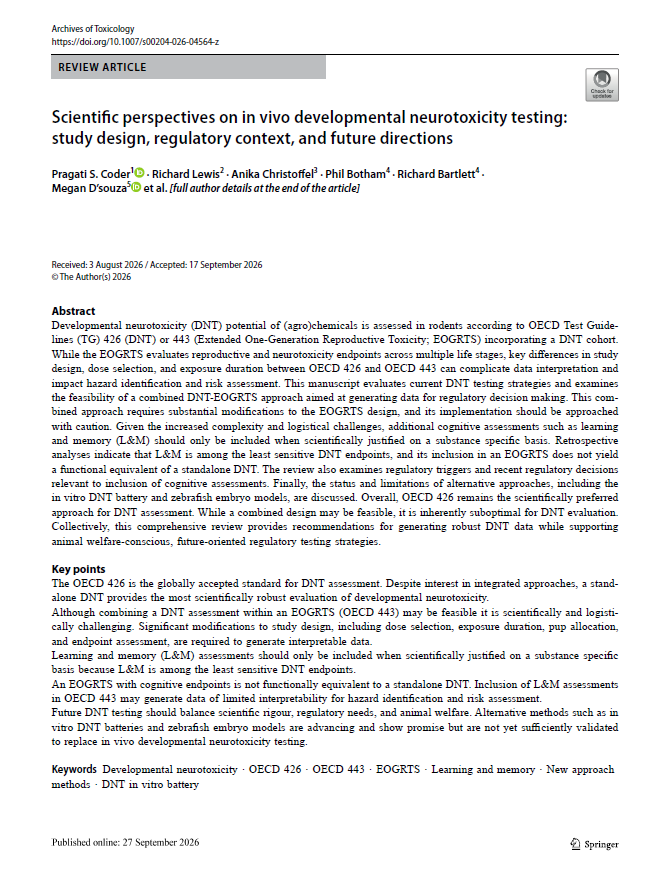
A Modular Approach to the Extended One-generation Reproduction Toxicity Study

This is the report of a combined initiative between the European Centre for Ecotoxicology and Toxicology of Chemicals (ECETOC) and the European Centre for the Validation of Alternative Methods (ECVAM), to evaluate triggers and waivers or an extended one-generation reproductive toxicity study, which is being developed as a test guideline by the Organisation for Economic Co-operation and Development (OECD). The initial phase of the work was concerned with reviewing the endpoints evaluated in current regulatory guidelines for developmental and reproductive toxicity and those in newly-published proposals for the evaluation of agrochemicals. In particular, the aim was to design an intelligent testing strategy for reproductive and developmental endpoints, which would be suitable for the evaluation of general industrial chemicals, and to propose triggers and waivers for the investigation of optional modules in an extended one-generation reproduction toxicity study. An additional aim was to describe the extent to which these trigger and waiving criteria could already be considered to be validated, and to propose additional validation steps, if needed.

The conclusions of the task force were published as ECETOC Document No. 45 (1), which served as the basis for a multi-stakeholder workshop organised by ECETOC and ECVAM, which took place on 14-15 April 2008, at Barza d'Ispra, Italy. The workshop participants were drawn from academia, the regulatory community, industry, and contract research organisations. The outcome of the discussions and recommendations agreed upon by the workshop was published as ECETOC Workshop Report No. 12 (2).

This report represents the summary findings of the task force, taking into consideration the consensus agreement of the workshop.

Reference

Authors : Nigel Moore, Susanne Bremer, Neil Carmichael, George Daston, Matt Dent, Wassila Gaoua-Chapelle, Nina Hallmark, Thomas Hartung, Beate Holzum, Ulrich Hübel, Marie-Louise Meisters, Steffen Schneider, Bennard van Ravenzwaay and Christa Hennes
Publisher : ATLA volume 37, pp 219-225, 2009

PMID: 19453218 [PubMed – indexed for MEDLINE]


Find out more
http://www.atla.org.uk/a-modular-approach-to-the-extended-one-generation-reproduction-toxicity-study/