






2025 Annual Report
Annual Report
ECETOC publishes a framework for the risk assessment of plastic additives
Press Release

ECETOC publishes a framework for the risk assessment of plastic additives

Part 1 sets out the fundamental elements, from problem formulation to risk characterisation.Brussels, 22 July 2026. The ECETOC Plastic Additives Task Force has published the first of two peer...
January 2026 news from the Sec Gen
News

January 2026 news from the Sec Gen

Dear colleagues and friends,As we begin a new year, I would like to thank you for your continued engagement and trust in ECETOC. 2026 promises to be an exciting and dynamic year, and I am pleased...
HSSD Tool

HSSD Tool

This software was developed by a consortium of partners to facilitate the uptake of novel approaches to estimate aquatic threshold concentrations (e.g. the concentration at which 5% of the species are exposed above their EC50, HC5).
The Human Exposure Assessment Tools Database (heatDB)

The Human Exposure Assessment Tools Database (heatDB)

heatdb is a public directory of exposure data sources as well as available tools for exposure
NanoApp

NanoApp

ECETOC’s NanoApp is a tool designed to define the boundaries of sets of similar nanoforms and to generate a justification for the REACH registration.
Targeted Risk Assessment (TRA)

Targeted Risk Assessment (TRA)

The Targeted Risk Assessment (TRA) estimates exposures to workers, consumers and the environment that arise during a series of events.
TRA Task Force – Worker branch

TRA Task Force – Worker branch

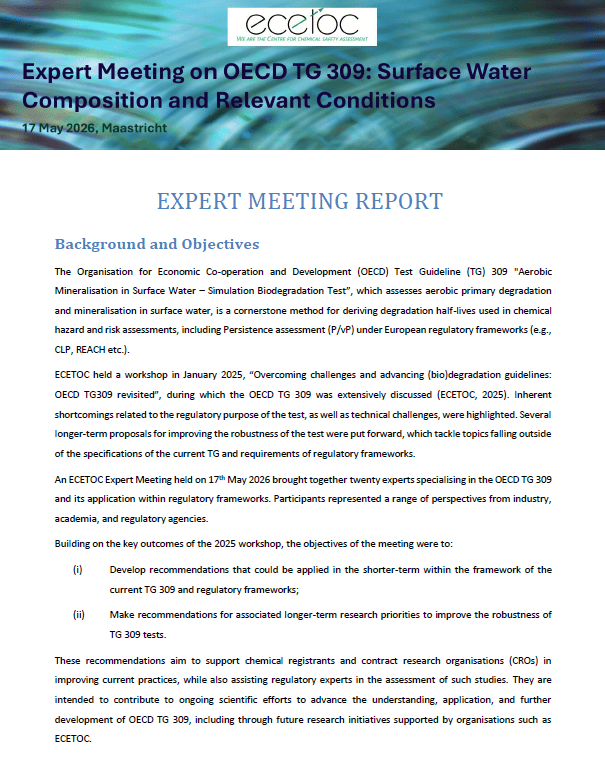
Why? The Worker TRA Task Force has been active since 2019, delivering projects that advance the scientific basis of the Worker Targeted Risk Assessment (TRA) tool. Its overarching objective is to e...
Immunotoxicity assessment: Addressing Challenges and Advancing Methodologies [Workshop → Task Force]​

Immunotoxicity assessment: Addressing Challenges and Advancing Methodologies [Workshop → Task Force]​

Why?Regulatory assessment of immunotoxic properties of chemicals is a complex and challenging task​ Limited regulatory guidance exists​ Lack of industry and regulatory knowledge​...
Chronic fish case studies towards an IATA

Chronic fish case studies towards an IATA

Why?Hazard and safety assessments for the pelagic compartment often rely on in vivo studies using a single fish species, raising ethical concerns and uncertainty in terms of extrapolation....
News
10.10.2023

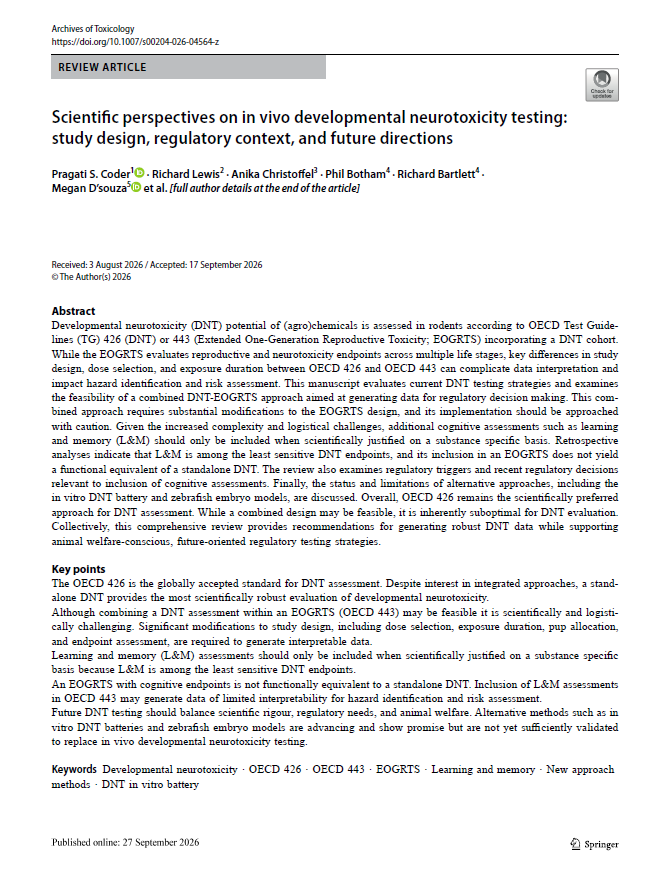
Call for Nominations for a new Task Force: ‘Scientific perspective on discussions about DNT testing in OECD 443-studies’

ECETOC will soon launch a new Task Force on DNT Testing OECD 443-studies and is looking for experts to join from academia, regulatory bodies; NGOs or member companies.

The Task Force's objective is to provide a scientific perspective on inclusion of learning and memory testing (two different mazes at two different time points) in OECD 443 (Extended One-Generation Reproductive Toxicity) studies with developmental neurotoxicity (DNT) cohorts, that would support decision makers/regulators to go ahead with a feasible proposal.

This would be achieved by:
1. Gathering information from available literature and research institutions, including Contract Research Organisations (CROs), to assess both the feasibility and the rationale behind incorporating the DNT cohort with two mazes.
2. Engaging in discussions and developing a proposal for the best scientific approach, including the statistical power and scientific integrity of a DNT study when including additional cohorts and endpoints.
3. Preparing a manuscript for publication in a peer-reviewed journal to disseminate our findings.

The Task Force kick-off meeting is expected to take place in Q4 2023, with a target completion timeframe of 9 months. Most meetings will be held remotely, with the possibility of one in-person meeting at the ECETOC offices in Brussels. The deliverable is anticipated to be a peer reviewed publication.

Please send nominations to lucy.wilmot@ecetoc.org by close of business 3 November 2023, for consideration by the Scientific Committee. Nominations should be accompanied by a brief CV (with list of relevant publications) and may include an indication of any particular contribution that the candidate could make to the Task Force.