



We’re Hiring: Join the ECETOC Team as a Trainee!
390494

We’re Hiring: Join the ECETOC Team as a Trainee!

Are you passionate about science, regulatory toxicology, and making a real-world impact at the intersection of industry, academia, and policy? ECETOC is excited to announce that we’re looking for a...
ECETOC publishes a framework for the risk assessment of plastic additives
390456

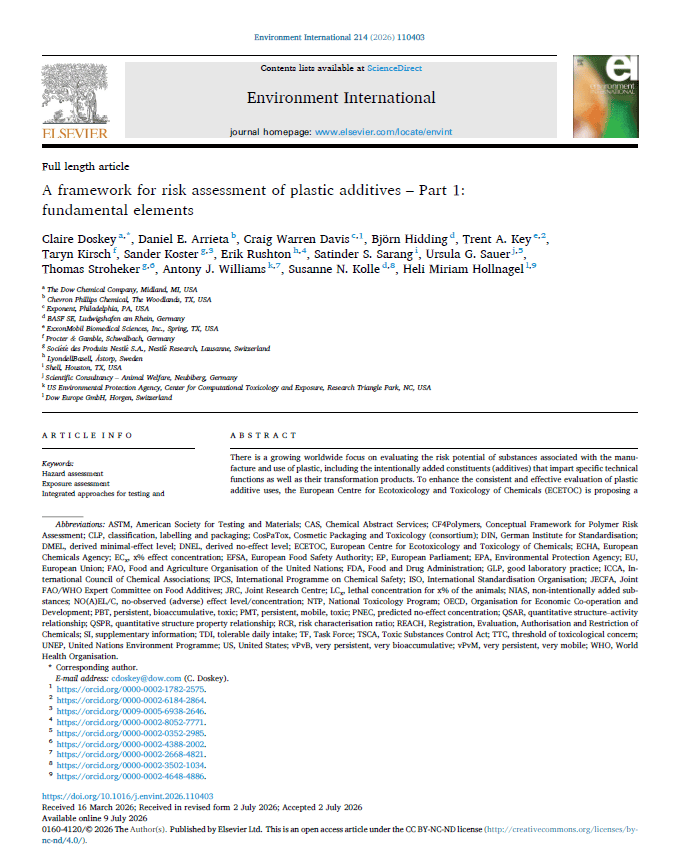
ECETOC publishes a framework for the risk assessment of plastic additives

Part 1 sets out the fundamental elements, from problem formulation to risk characterisation.Brussels, 22 July 2026. The ECETOC Plastic Additives Task Force has published the first of two peer...
HSSD Tool

HSSD Tool

This software was developed by a consortium of partners to facilitate the uptake of novel approaches to estimate aquatic threshold concentrations (e.g. the concentration at which 5% of the species are exposed above their EC50, HC5).
The Human Exposure Assessment Tools Database (heatDB)

The Human Exposure Assessment Tools Database (heatDB)

heatdb is a public directory of exposure data sources as well as available tools for exposure
NanoApp

NanoApp

ECETOC’s NanoApp is a tool designed to define the boundaries of sets of similar nanoforms and to generate a justification for the REACH registration.
Targeted Risk Assessment (TRA)

Targeted Risk Assessment (TRA)

The Targeted Risk Assessment (TRA) estimates exposures to workers, consumers and the environment that arise during a series of events.
TRA Task Force – Worker branch

TRA Task Force – Worker branch

Why? The Worker TRA Task Force has been active since 2019, delivering projects that advance the scientific basis of the Worker Targeted Risk Assessment (TRA) tool. Its overarching objective is to e...
Immunotoxicity assessment: Addressing Challenges and Advancing Methodologies [Workshop → Task Force]​

Immunotoxicity assessment: Addressing Challenges and Advancing Methodologies [Workshop → Task Force]​

Why?Regulatory assessment of immunotoxic properties of chemicals is a complex and challenging task​ Limited regulatory guidance exists​ Lack of industry and regulatory knowledge​...
Chronic fish case studies towards an IATA

Chronic fish case studies towards an IATA

Why?Hazard and safety assessments for the pelagic compartment often rely on in vivo studies using a single fish species, raising ethical concerns and uncertainty in terms of extrapolation....
Event
17.02.2015 - 18.02.2015

Workshop on the improvement of the OECD 306 screening test

Workshop on the improvement of the OECD 306 screening test

at the CEFAS (Centre for Environment, Fisheries & Aquaculture Science ) laboratories, Lowestoft, UK on the 17th and 18th February 2015

Recent ECETOC workshops recommended a series of modifications and enhancements to existing OECD biodegradation screening tests to deliver more robust methods for assessing persistence [1]. This reflects the high variability and poor reliability previously reported in OECD biodegradation screening tests such as the OECD 306, marine biodegradation test [2,3,4].

The Cefic-LRi funded Eco11 [5] investigated and validated these enhancements, producing a framework for selecting the most suitable inocula cell concentration method for improved enhanced activated sludge (c.f. OECD 301) and marine tests (c.f. OECD 306). The plan is that these improvements will lead to a ring test of an enhanced OECD 306 test, which is of considerable interest to OSPAR and other regulators.

This workshop introduced the concepts and hands-on lab-based training so that any facilities interested in participating in a ring test will have the knowledge to do so. The workshop consisted of:

• Half a day of the theory, concepts and scientific evaluation of cell concentration methods and enhanced tests.

•  Half a day of a practical demonstration of a cell concentration method for aqueous inocula (e.g. an enhanced OECD 306 test).

A short discussion of the practice of the Marine BODIS test was also included.

The Cefic-LRi sponsored workshop was delivered by the Eco 11 LRI team (Newcastle University and AstraZeneca) at the CEFAS (Centre for Environment, Fisheries & Aquaculture Science ) laboratories, Lowestoft, UK on the 17th and 18th February 2015.

A demonstration of Tangential Flow Filtration to Concentrate Aqueous Environmental Samples by Dr Timothy Martin & Dr Russell Davenport of Newcastle University - School of Civil Engineering & Geosciences was recorded and can be viewed on YouTube at https://youtu.be/EcT8848hDE4