













2025 Annual Report
Annual Report
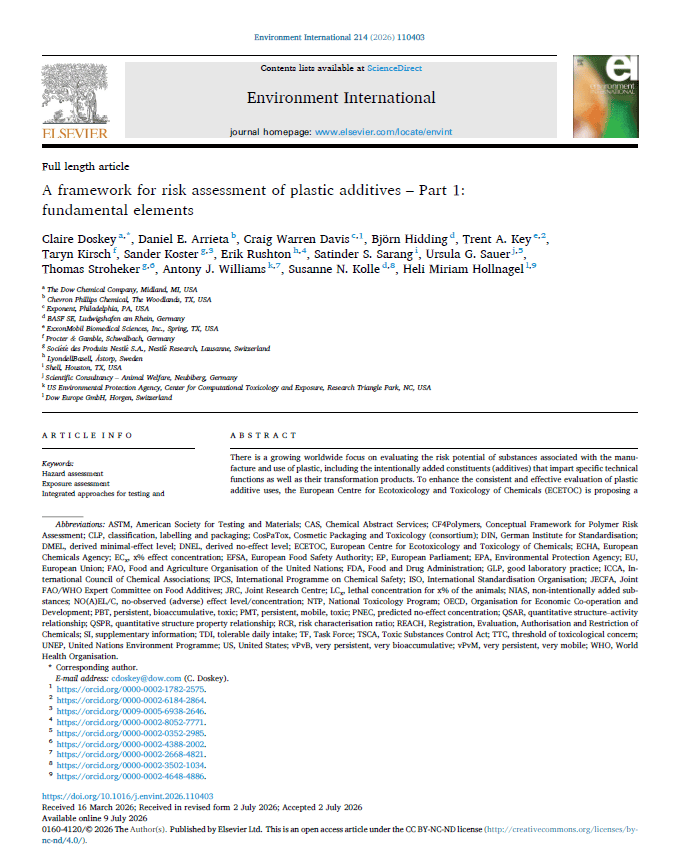
ECETOC publishes a framework for the risk assessment of plastic additives
Press Release

ECETOC publishes a framework for the risk assessment of plastic additives

Part 1 sets out the fundamental elements, from problem formulation to risk characterisation.Brussels, 22 July 2026. The ECETOC Plastic Additives Task Force has published the first of two peer...
January 2026 news from the Sec Gen
News

January 2026 news from the Sec Gen

Dear colleagues and friends,As we begin a new year, I would like to thank you for your continued engagement and trust in ECETOC. 2026 promises to be an exciting and dynamic year, and I am pleased...
HSSD Tool

HSSD Tool

This software was developed by a consortium of partners to facilitate the uptake of novel approaches to estimate aquatic threshold concentrations (e.g. the concentration at which 5% of the species are exposed above their EC50, HC5).
The Human Exposure Assessment Tools Database (heatDB)

The Human Exposure Assessment Tools Database (heatDB)

heatdb is a public directory of exposure data sources as well as available tools for exposure
NanoApp

NanoApp

ECETOC’s NanoApp is a tool designed to define the boundaries of sets of similar nanoforms and to generate a justification for the REACH registration.
Targeted Risk Assessment (TRA)

Targeted Risk Assessment (TRA)

The Targeted Risk Assessment (TRA) estimates exposures to workers, consumers and the environment that arise during a series of events.
Chronic fish case studies towards an IATA

Chronic fish case studies towards an IATA

Why?Hazard and safety assessments for the pelagic compartment often rely on in vivo studies using a single fish species, raising ethical concerns and uncertainty in terms of extrapolation....
Estimating the environmental release of Synthetic Polymeric Microparticles from Products

Estimating the environmental release of Synthetic Polymeric Microparticles from Products

Why?REACH restriction: SPM use restricted; emissions reporting required by May 2027. Gap: No analytical methods available to measure SPM emissions. Solution: Draft SPERC-based approac...
Case Studies on Reliability and Relevance Considerations during Validation of NAMs

Case Studies on Reliability and Relevance Considerations during Validation of NAMs

Why?Validation of NAMs is often overlooked despite its importance for regulatory use. Traditional validation methods are less suitable for NAMs, which focus on key events rather than apical...
Event
03.03.2016 - 04.03.2016

Noncoding RNAs and Risk Assessment Science

03-04 March 2016, Malaga, Spain

Background

Noncoding RNAs are now known to be involved in post transcriptional gene silencing, epigenetic regulation and mediation of physical and chemical environmental signals. However, although knowledge of how chemical stressors can influence the functionality of ncRNAs is growing, the potential role of ncRNAs in chemicals risk assessment is unclear. This workshop intends to reach a common understanding on the current and potential future role of ncRNAs in toxicology and risk assessment – and develop a prioritised research agenda for research over the next 2-3 years in this regard.

Objectives of the workshop

Day 1 consisted of a series of talks and case studies with room for questions, focussing on:

  • Understanding ncRNAs: their physiology, mechanisms of action, functional relevance and possible role in human pathology.
  •  Understand relevance of ncRNA in toxicology and risk assessment of chemicals

Day 2 consisted of brainstorming activity in which participants worked in breakout groups to:

  • Get clarity on data analysis and data interpretation: what is relevant for toxicology and risk assessment?
  •  Assess whether current toxicology and chemicals risk assessment should be re-evaluated in light of current knowledge of ncRNA
  • Develop a prioritised research agenda

Outcome

Paper:
Aigner et al, 2016