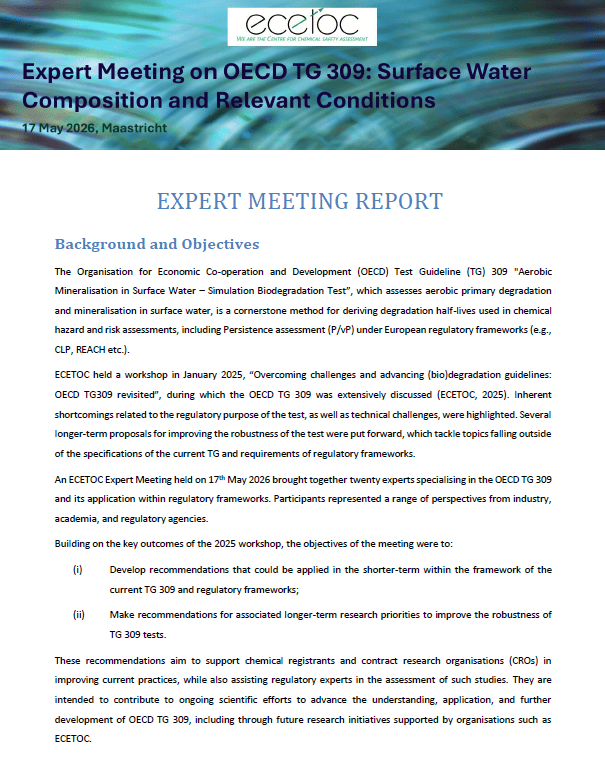







We’re Hiring: Join the ECETOC Team as a Trainee!
390494

We’re Hiring: Join the ECETOC Team as a Trainee!

Are you passionate about science, regulatory toxicology, and making a real-world impact at the intersection of industry, academia, and policy? ECETOC is excited to announce that we’re looking for a...
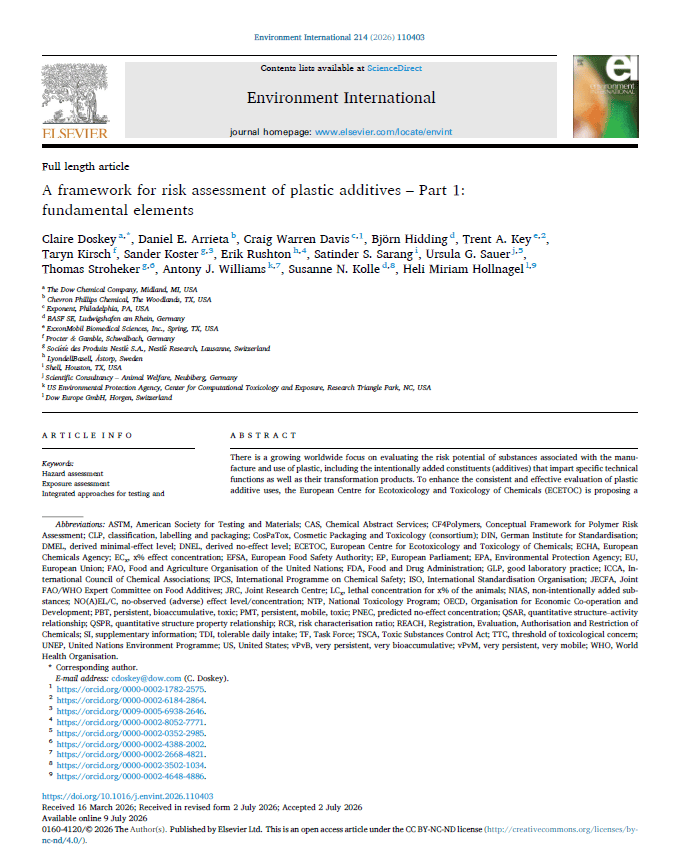
ECETOC publishes a framework for the risk assessment of plastic additives
390456

ECETOC publishes a framework for the risk assessment of plastic additives

Part 1 sets out the fundamental elements, from problem formulation to risk characterisation.Brussels, 22 July 2026. The ECETOC Plastic Additives Task Force has published the first of two peer...
HSSD Tool

HSSD Tool

This software was developed by a consortium of partners to facilitate the uptake of novel approaches to estimate aquatic threshold concentrations (e.g. the concentration at which 5% of the species are exposed above their EC50, HC5).
The Human Exposure Assessment Tools Database (heatDB)

The Human Exposure Assessment Tools Database (heatDB)

heatdb is a public directory of exposure data sources as well as available tools for exposure
NanoApp

NanoApp

ECETOC’s NanoApp is a tool designed to define the boundaries of sets of similar nanoforms and to generate a justification for the REACH registration.
Targeted Risk Assessment (TRA)

Targeted Risk Assessment (TRA)

The Targeted Risk Assessment (TRA) estimates exposures to workers, consumers and the environment that arise during a series of events.
TRA Task Force – Worker branch

TRA Task Force – Worker branch

Why? The Worker TRA Task Force has been active since 2019, delivering projects that advance the scientific basis of the Worker Targeted Risk Assessment (TRA) tool. Its overarching objective is to e...
Immunotoxicity assessment: Addressing Challenges and Advancing Methodologies [Workshop → Task Force]​

Immunotoxicity assessment: Addressing Challenges and Advancing Methodologies [Workshop → Task Force]​

Why?Regulatory assessment of immunotoxic properties of chemicals is a complex and challenging task​ Limited regulatory guidance exists​ Lack of industry and regulatory knowledge​...
Chronic fish case studies towards an IATA

Chronic fish case studies towards an IATA

Why?Hazard and safety assessments for the pelagic compartment often rely on in vivo studies using a single fish species, raising ethical concerns and uncertainty in terms of extrapolation....
Event
27.10.2016 - 28.10.2016

ECETOC Workshop on Chemical Respiratory Allergy: Clinical Information and how to use it and improve it

27-28 October 2016, NH Nacional Hotel, Madrid, Spain

Aims of the Workshop

Specific Objectives:

  1. Develop best practice guidance on how to assess and use available human data for the identification and regulation of respiratory sensitizers, including the creation of a framework for the interpretation of strength of evidence and weighting.
  2. Explore opportunities to identify biomarkers for sensitisation to chemical respiratory allergens – and the use of such biomarkers for prospective monitoring of workforces to more accurately identify threshold data.

Output

  1. Define and promote a consistent, best practice, strategy for the evaluation of available human data for respiratory sensitizers, for use by regulators in formal decision-making processes.
  2. Publish a consensus opinion on the research required for the identification of human biomarkers of chemical respiratory sensitisation, and application in prospective monitoring of workforces with the ultimate aim of refining current human threshold data to reduce uncertainty in current risk assessment approaches.

Organising Committee

Stella Cochrane (Unilever)
Andreas Flueckiger   (F. Hoffmann-La Roche)
Helmut Greim (Technical University, Munich)
Stuart Hindle (Dow)
Ian Kimber (University of Manchester)
Carlos Rodriguez (P&G)
Madeleine Laffont (ECETOC)
Alan Poole (ECETOC)

Workshop Report

  • See also accepted manuscript in press:
    Basketter D, Poole A, Kimber I. 2017.
    Behaviour of chemical respiratory allergens in novel predictive methods for skin sensitisation.
    Regul Toxicol Pharmacol Available online 6 March 2017  [Open Access]
    Doi 10.1016/j.yrtph.2017.03.002