







2025 Annual Report
Annual Report
ECETOC publishes a framework for the risk assessment of plastic additives
Press Release

ECETOC publishes a framework for the risk assessment of plastic additives

Part 1 sets out the fundamental elements, from problem formulation to risk characterisation.Brussels, 22 July 2026. The ECETOC Plastic Additives Task Force has published the first of two peer...
January 2026 news from the Sec Gen
News

January 2026 news from the Sec Gen

Dear colleagues and friends,As we begin a new year, I would like to thank you for your continued engagement and trust in ECETOC. 2026 promises to be an exciting and dynamic year, and I am pleased...
HSSD Tool

HSSD Tool

This software was developed by a consortium of partners to facilitate the uptake of novel approaches to estimate aquatic threshold concentrations (e.g. the concentration at which 5% of the species are exposed above their EC50, HC5).
The Human Exposure Assessment Tools Database (heatDB)

The Human Exposure Assessment Tools Database (heatDB)

heatdb is a public directory of exposure data sources as well as available tools for exposure
NanoApp

NanoApp

ECETOC’s NanoApp is a tool designed to define the boundaries of sets of similar nanoforms and to generate a justification for the REACH registration.
Targeted Risk Assessment (TRA)

Targeted Risk Assessment (TRA)

The Targeted Risk Assessment (TRA) estimates exposures to workers, consumers and the environment that arise during a series of events.
Immunotoxicity assessment: Addressing Challenges and Advancing Methodologies [Workshop → Task Force]​

Immunotoxicity assessment: Addressing Challenges and Advancing Methodologies [Workshop → Task Force]​

Why?Regulatory assessment of immunotoxic properties of chemicals is a complex and challenging task​ Limited regulatory guidance exists​ Lack of industry and regulatory knowledge​...
Chronic fish case studies towards an IATA

Chronic fish case studies towards an IATA

Why?Hazard and safety assessments for the pelagic compartment often rely on in vivo studies using a single fish species, raising ethical concerns and uncertainty in terms of extrapolation....
Estimating the environmental release of Synthetic Polymeric Microparticles from Products

Estimating the environmental release of Synthetic Polymeric Microparticles from Products

Why?REACH restriction: SPM use restricted; emissions reporting required by May 2027. Gap: No analytical methods available to measure SPM emissions. Solution: Draft SPERC-based approac...
Task Force
04.08.2026

TRA Task Force – Worker branch

Why?

The Worker TRA Task Force has been active since 2019, delivering projects that advance the scientific basis of the Worker Targeted Risk Assessment (TRA) tool. Its overarching objective is to enhance the tool's performance and maintain confidence in its use for occupational exposure assessment.

A review in recent years of published validation studies comparing Worker TRA model predictions with measured inhalation and dermal exposure data from workplace settings informed a targeted update of the tool. This work led to the release of TRA Worker v3.2 in 2023, incorporating targeted evidence-based refinements which added further conservatism to the tool. The updated version introduced lower base estimates for certain inhalation and dermal exposure scenarios and reduced assumptions regarding the effectiveness of local exhaust ventilation for others.
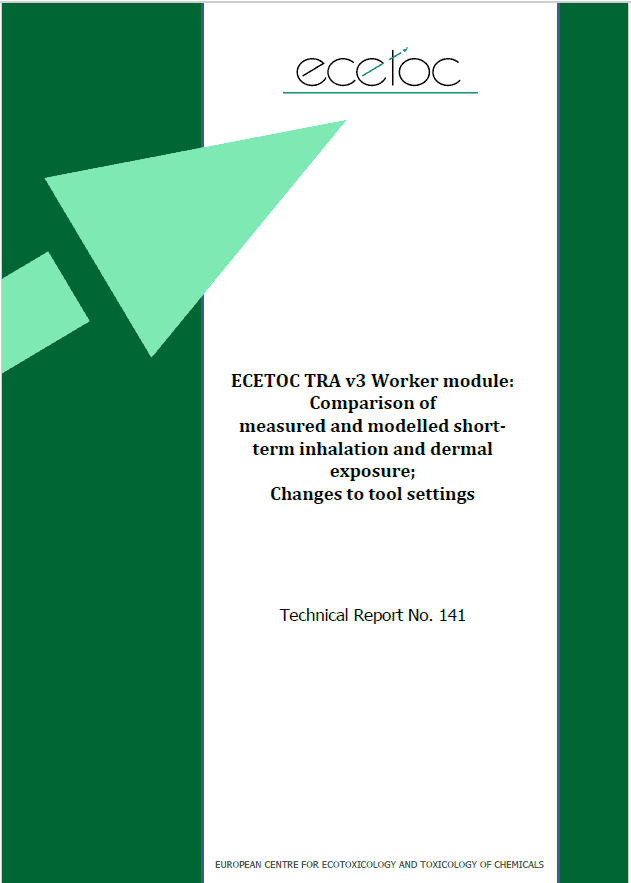
The scientific basis for this work and details of the updates are presented in ECETOC Technical Reports No. 140 and No. 141, and in Savic et al. (2023).

Despite these advances, important data and knowledge gaps remain. The Task Force continues to review emerging evidence and identify opportunities for further refinement of the Worker TRA tool.​

Objectives

  • Review and clarify justifications for TRA Worker tool parameters
  • Improve or clarify TRA Worker tool performance or applicability domain
  • Improve guidance on use of TRA Worker tool
  • Respond to stakeholder and/or user queries on TRA Worker tool
  • Seek external dialogue in order to build trust​


Click here to download the TRA Tool, access User Guides, FAQs and background reading materials.