






2nd ICCA MARII Workshop
12.06.2023 - 14.06.2023
Launching Soon: Polymer Analytics Task Force
376837

Launching Soon: Polymer Analytics Task Force

ECETOC is launching the Polymer Analytics Task Force to develop and standardize methods for analysing polymer properties essential for safety assessment. This initiative comes in response to the growi...
Opportunities to get involved – Sept. 2024
376836

Opportunities to get involved – Sept. 2024

Interested in recent updates and getting involved in ECETOC's work? Here's a look at a few upcoming initiatives:Be the next ECETOC representative in the ECHA ED Expert Group. We are looking for...
HSSD Tool

HSSD Tool

This software was developed by a consortium of partners to facilitate the uptake of novel approaches to estimate aquatic threshold concentrations (e.g. the concentration at which 5% of the species are exposed above their EC50, HC5).
The Human Exposure Assessment Tools Database (heatDB)

The Human Exposure Assessment Tools Database (heatDB)

heatdb is a public directory of exposure data sources as well as available tools for exposure
NanoApp

NanoApp

ECETOC’s NanoApp is a tool designed to define the boundaries of sets of similar nanoforms and to generate a justification for the REACH registration.
Targeted Risk Assessment (TRA)

Targeted Risk Assessment (TRA)

The Targeted Risk Assessment (TRA) estimates exposures to workers, consumers and the environment that arise during a series of events.
Dose Selection Task Force

Dose Selection Task Force

Background Recent opinions published by the RAC on low top dose selection in animal toxicity studies have indicated an apparent intent of increasing dosages systematically in view of the criteria u...
Mid-tier approach to aggregated exposure assessment TF

Mid-tier approach to aggregated exposure assessment TF

Background There are increasing public and regulatory concerns regarding potential health risks posed by aggregate exposure, i.e. exposure to (the same) substance from multiple sources via multiple...
Moving persistence (P) assessments into the 21st Century: Developing a new paradigm to assess degradation potential of chemicals

Moving persistence (P) assessments into the 21st Century: Developing a new paradigm to assess degradation potential of chemicals

Background Recent progress in the scientific understanding of the underlying processes of persistence and degradation has provided an opportunity to develop an improved framework and best practices...
Workshop Report
09.09.2026

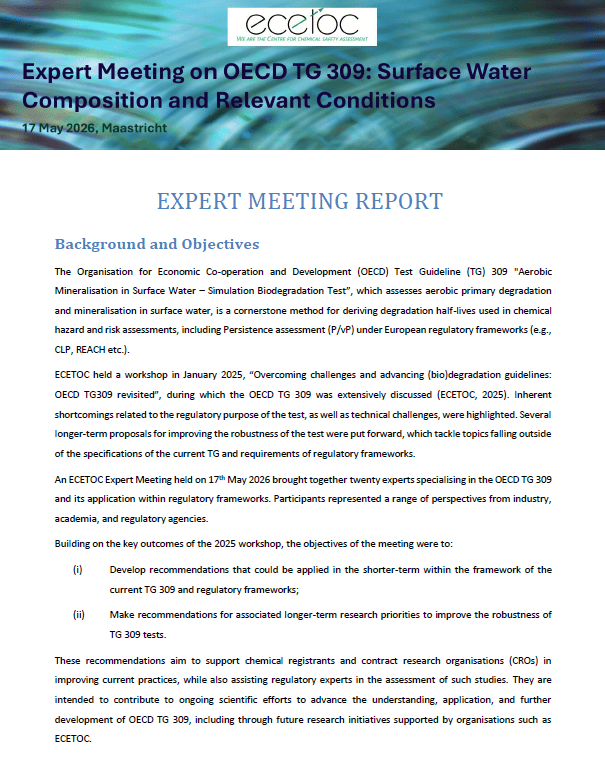
Expert Report: Advancing OECD TG 309 biodegradation testing

In a nutshell
This expert meeting report highlights key findings from ECETOC discussions on improving the OECD Test Guideline 309, which is used to assess the biodegradation of chemicals in surface water. The meeting brought together experts from industry, academia and regulatory authorities to examine the test’s environmental relevance, variability and reliability for regulatory persistence assessments.
The report summarises key insights, including the strong influence of surface-water inoculum and test conditions on degradation outcomes. It presents practical short-term recommendations to improve current testing, alongside longer-term research priorities aimed at strengthening the robustness, comparability and regulatory interpretation of OECD TG 309 studies.