








![Immunotoxicity assessment: Addressing Challenges and Advancing Methodologies [Workshop → Task Force]](https://www.ecetoc.org/wp-content/uploads/2026/07/Picture2-1024x923.jpg)



ECETOC Publication Highlights Scientific Perspectives on Developmental Neurotoxicity Testing and Future Regulatory Directions
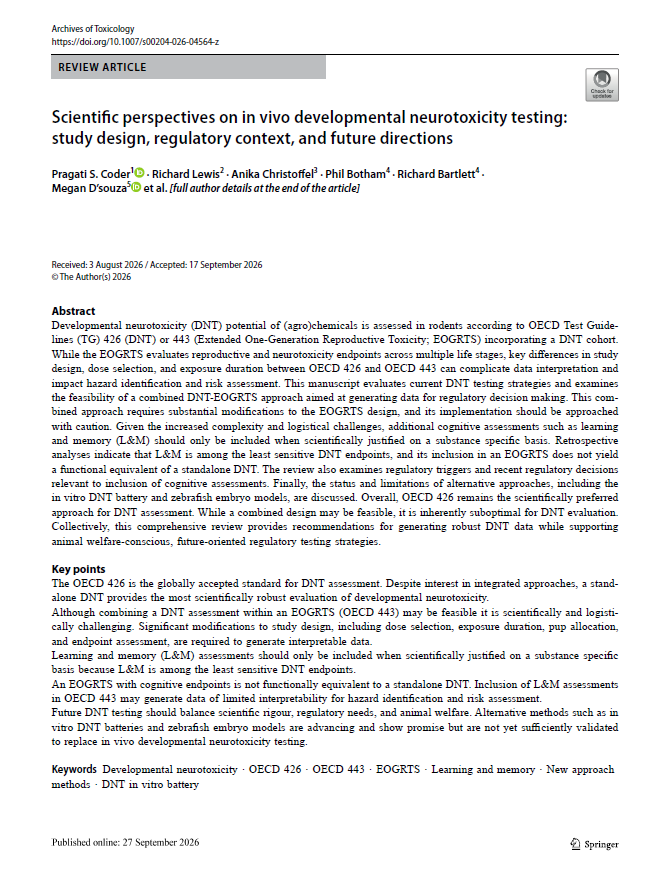
Brussels, 1 October 2026 – ECETOC is pleased to announce the publication of a new review article in Archives of Toxicology titled “Scientific Perspectives on In Vivo Developmental Neurotoxicity Testing: Study Design, Regulatory Context, and Future Directions” from the Scientific Perspectives on in vivo DNT Task Force.
Developmental neurotoxicity (DNT) testing plays a critical role in assessing whether chemicals may interfere with the normal development of the nervous system. As regulatory authorities increasingly seek efficient and scientifically robust approaches to hazard and risk assessment, questions have emerged regarding the optimal design of animal studies used to evaluate potential DNT effects.
The newly published review provides a comprehensive evaluation of current in vivo DNT testing strategies, including the widely used OECD Test Guideline (TG) 426 and the OECD TG 443 Extended One-Generation Reproductive Toxicity Study (EOGRTS) with a developmental neurotoxicity cohort. The authors examine the scientific and regulatory implications of these approaches and assess the feasibility of combining DNT assessments within the EOGRTS framework.
The review highlights that important differences between OECD TG 426 and OECD TG 443, including study design, dose selection, and exposure duration, can significantly influence data interpretation and regulatory decision-making. While a combined DNT-EOGRTS approach appears technically feasible, the authors conclude that substantial modifications would be required and that such an approach should be implemented cautiously.
A key focus of the paper is the inclusion of cognitive assessments, particularly learning and memory (L&M) endpoints. Based on retrospective analyses and regulatory experience, the authors find that L&M represents one of the least sensitive DNT endpoints and that its inclusion within an EOGRTS does not provide a functional equivalent to a standalone DNT study. The review therefore recommends that additional cognitive testing should only be introduced when there is a clear, substance-specific scientific rationale.
The publication also reviews recent regulatory developments and decision-making practices related to DNT testing. In addition, it discusses emerging New Approach Methodologies (NAMs), including the in vitro DNT battery and zebrafish embryo models, highlighting both their potential and current limitations in supporting regulatory assessments.
Overall, the authors conclude that OECD TG 426 remains the scientifically preferred approach for developmental neurotoxicity assessment. Although combined testing strategies may offer certain efficiencies, they are inherently less optimal for evaluating DNT outcomes. The review provides practical recommendations aimed at generating robust and reliable DNT data while supporting future-oriented and animal welfare-conscious testing strategies.
For more information and access to the publication, please click here: https://doi.org/10.1007/s00204-026-04564-z