






![Immunotoxicity assessment: Addressing Challenges and Advancing Methodologies [Workshop → Task Force]](https://www.ecetoc.org/wp-content/uploads/2026/07/Picture2-1024x923.jpg)



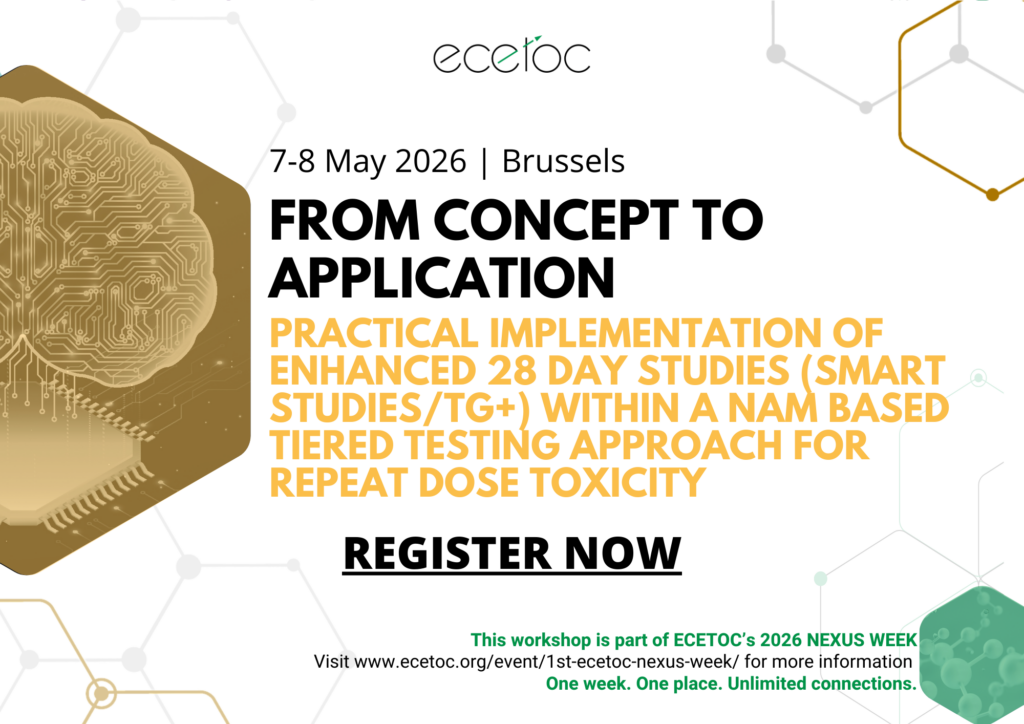
Smart studies: Examine how in vivo studies could provide more information encompassing novel studies (and endpoints)
Why?
“Smart” or extended studies can be defined as in vivo studies that employ additional or different endpoints from conventional studies.
They fall into 2 categories:
- those that follow up on activity from in silico/in vitro lines of evidence to explore potential severity and potency
- those that follow up on lack of activity in silico/in vitro lines of evidence to provide assurance on lack of toxicity.
They are routinely used in agrochemical R&D to select candidates for development including conventional studies.
Looking forward, could smart studies be designed to provide a higher level of evidence that allows classification and the derivation of Health‐Based Guidance Values (HBGVs)? Could these studies be based on screening studies already included in REACH guidelines? Could the screening studies be enhanced to be more definitive?
There is an opportunity to apply non-conventional OMICs base methods to enhance in vivo studies, which would lead to more information from the same or fewer number of animals studies while maintaining or improving the level of knowledge and confidence.
This should increase the level of knowledge for lower tonnage chemicals and reduce the need for high animal usage studies e.g. carcinogenicity and multi- or extended-1-generation and developmental toxicity studies at higher tonnages.
This Task Force is part of the ECETOC Transformational Programme No. 2 ‘Development of an Integrated Approach for Chemicals Assessment’.
Objectives
- Improve the quality and regulatory value of animal testing, increase human relevance of such testing, meeting knowledge/information needs in a targeted way
- Determine how these studies fit into a tiered approach with other information e.g in vitro
- Describe how these studies fit into an overall weight of evidence approach, integration with other lines of evidence and information
- Define when these studies should be used. E.g explore indications from in vitro, provide assurance on apparent lack of activity
- Explore the global impact
- Translation guidance to regulators who have to assess data
Timeline and Deliverables
Work started in 2023 and the TF has plans to submit a manuscript to a peer review journal.