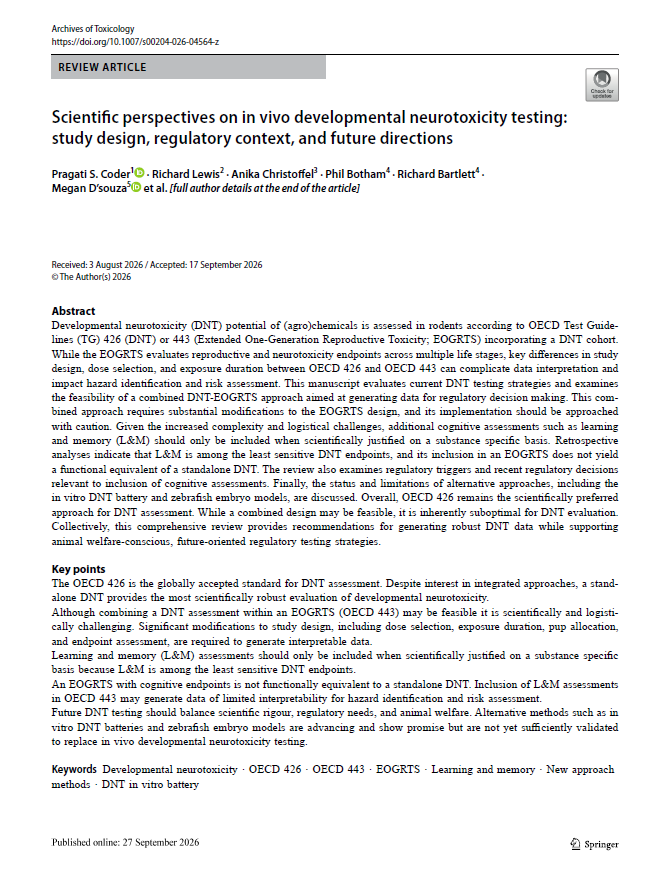
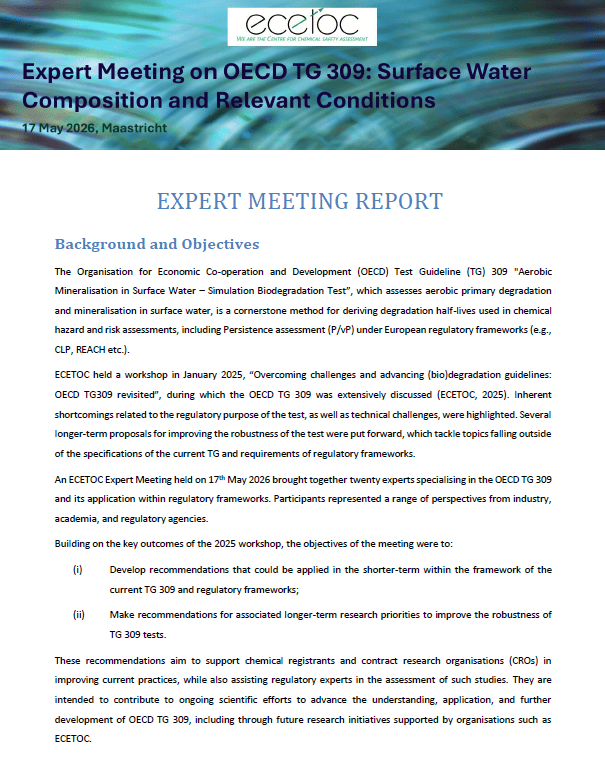


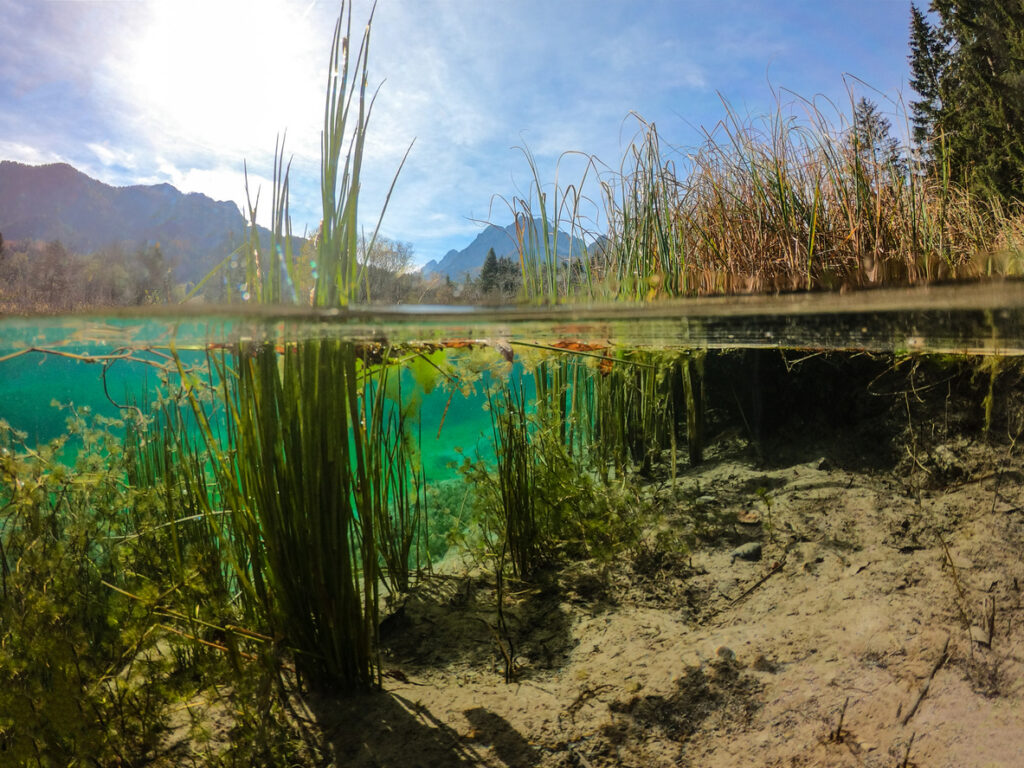




New ECETOC expert report: Advancing OECD TG 309 biodegradation testing
390508

New ECETOC expert report: Advancing OECD TG 309 biodegradation testing

A new expert meeting report is now available on the ECETOC website exploring how OECD TG 309 can be made more robust and environmentally relevant for chemical persistence assessment. The report ref...
We’re Hiring: Join the ECETOC Team as a Trainee!
390494

We’re Hiring: Join the ECETOC Team as a Trainee!

Are you passionate about science, regulatory toxicology, and making a real-world impact at the intersection of industry, academia, and policy? ECETOC is excited to announce that we’re looking for a...
HSSD Tool

HSSD Tool

This software was developed by a consortium of partners to facilitate the uptake of novel approaches to estimate aquatic threshold concentrations (e.g. the concentration at which 5% of the species are exposed above their EC50, HC5).
The Human Exposure Assessment Tools Database (heatDB)

The Human Exposure Assessment Tools Database (heatDB)

heatdb is a public directory of exposure data sources as well as available tools for exposure
NanoApp

NanoApp

ECETOC’s NanoApp is a tool designed to define the boundaries of sets of similar nanoforms and to generate a justification for the REACH registration.
Targeted Risk Assessment (TRA)

Targeted Risk Assessment (TRA)

The Targeted Risk Assessment (TRA) estimates exposures to workers, consumers and the environment that arise during a series of events.
TRA Task Force – Worker branch

TRA Task Force – Worker branch

Why? The Worker TRA Task Force has been active since 2019, delivering projects that advance the scientific basis of the Worker Targeted Risk Assessment (TRA) tool. Its overarching objective is to e...
Immunotoxicity assessment: Addressing Challenges and Advancing Methodologies [Workshop → Task Force]​

Immunotoxicity assessment: Addressing Challenges and Advancing Methodologies [Workshop → Task Force]​

Why?Regulatory assessment of immunotoxic properties of chemicals is a complex and challenging task​ Limited regulatory guidance exists​ Lack of industry and regulatory knowledge​...
Chronic fish case studies towards an IATA

Chronic fish case studies towards an IATA

Why?Hazard and safety assessments for the pelagic compartment often rely on in vivo studies using a single fish species, raising ethical concerns and uncertainty in terms of extrapolation....
Article
02.05.2000

Removal of linear alkylbenzene sulfonate from a small Yorkshire stream: Contribution to GREAT-ER project # 7

An in-stream removal experiment has been carried out in Red Beck, a small stream which receives effluent from Shibden Head Sewage Treatment Works. This trickling filter works serves a purely domestic population of 9408 but is scheduled to be closed, and the flows diverted to another works, as part of Yorkshire Water?s continuing capital investment programme. An anionic detergent, linear alkylbenzene sulfonate (LAS), boron, and standard water quality parameters have been measured at seven sites downstream of the effluent discharge point. Time of travel has been measured by detection of a fluorescent dye added to the effluent sampling chamber, and the increase in flow as the river proceeds through the catchment has been determined from current flow measurements, and from boron dilution data. Assuming a first order removal mechanism, the overall half-life for LAS removal is just over 2 h (2 h 14 min). Faster removal takes place in the upper portion of the stream, and removal over the last five sampling points is somewhat slower, with a half-life of 2 h 40 min. This removal may comprise both primary biodegradation and the deposition of suspended matter to which the surfactant has been adsorbed. There was no significant difference in the removal half-lives of the individual alkyl chain length homologues.

Reference

Authors : Kay Fox, Unilever Research; Martin Holt, ECETOC; Mic Daniel, Environment Agency UK; Harold Buckland, Yorkshire Water; Ian Guymer, Department of Civil and Structural Engineering, University of Sheffield
Publisher : The Science of the Total Environment, Volumes 251-252 , 5 May 2000, Pages 265-275


Find out more
http://dx.doi.org/10.1016/S0048-9697(00)00389-2