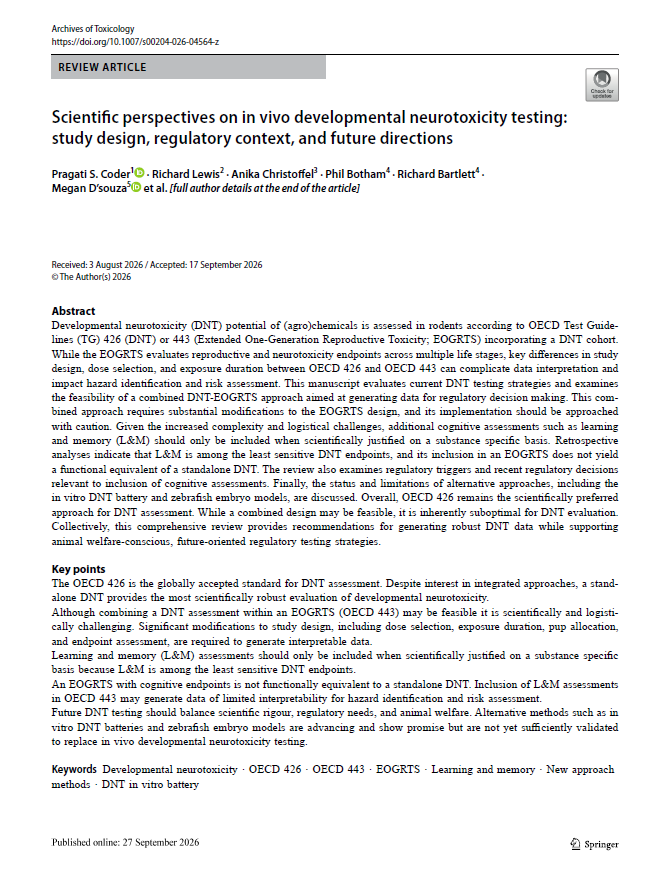
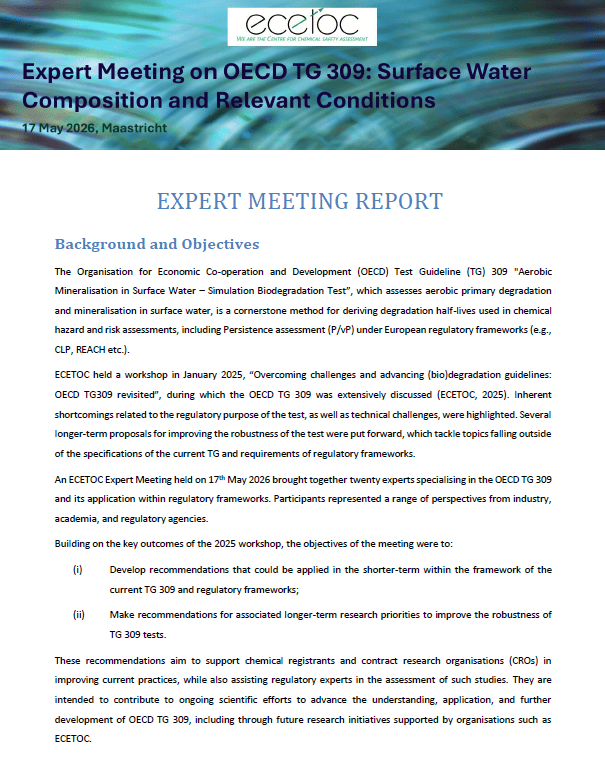







New ECETOC expert report: Advancing OECD TG 309 biodegradation testing
390508

New ECETOC expert report: Advancing OECD TG 309 biodegradation testing

A new expert meeting report is now available on the ECETOC website exploring how OECD TG 309 can be made more robust and environmentally relevant for chemical persistence assessment. The report ref...
We’re Hiring: Join the ECETOC Team as a Trainee!
390494

We’re Hiring: Join the ECETOC Team as a Trainee!

Are you passionate about science, regulatory toxicology, and making a real-world impact at the intersection of industry, academia, and policy? ECETOC is excited to announce that we’re looking for a...
HSSD Tool

HSSD Tool

This software was developed by a consortium of partners to facilitate the uptake of novel approaches to estimate aquatic threshold concentrations (e.g. the concentration at which 5% of the species are exposed above their EC50, HC5).
The Human Exposure Assessment Tools Database (heatDB)

The Human Exposure Assessment Tools Database (heatDB)

heatdb is a public directory of exposure data sources as well as available tools for exposure
NanoApp

NanoApp

ECETOC’s NanoApp is a tool designed to define the boundaries of sets of similar nanoforms and to generate a justification for the REACH registration.
Targeted Risk Assessment (TRA)

Targeted Risk Assessment (TRA)

The Targeted Risk Assessment (TRA) estimates exposures to workers, consumers and the environment that arise during a series of events.
TRA Task Force – Worker branch

TRA Task Force – Worker branch

Why? The Worker TRA Task Force has been active since 2019, delivering projects that advance the scientific basis of the Worker Targeted Risk Assessment (TRA) tool. Its overarching objective is to e...
Immunotoxicity assessment: Addressing Challenges and Advancing Methodologies [Workshop → Task Force]​

Immunotoxicity assessment: Addressing Challenges and Advancing Methodologies [Workshop → Task Force]​

Why?Regulatory assessment of immunotoxic properties of chemicals is a complex and challenging task​ Limited regulatory guidance exists​ Lack of industry and regulatory knowledge​...
Chronic fish case studies towards an IATA

Chronic fish case studies towards an IATA

Why?Hazard and safety assessments for the pelagic compartment often rely on in vivo studies using a single fish species, raising ethical concerns and uncertainty in terms of extrapolation....
Article
26.07.2016

Guidance on the selection of cohorts for the extended one-generation reproduction toxicity study (OECD test guideline 443)

In a nutshell

The extended one-generation reproduction toxicity study
(EOGRTS; OECD test guideline 433) is a new and technically complex design to evaluate the putative effects of chemicals on fertility and development, including effects upon the developing nervous and immune systems. In addition to offering a more comprehensive assessment of developmental toxicity, the EOGRTS offers important improvements in animal welfare through reduction and refinement in a modular study design. The challenge to the practitioner is to know how the modular aspects of the study should be triggered on the basis of prior knowledge of a particular chemical, or on earlier findings in the EOGRTS itself, requirements of specific regulatory frameworks notwithstanding. The purpose of this document is to offer guidance on science-based triggers for these extended evaluations.

Reference

Moore NP, Beekhuijzen M, Boogaard PJ, Foreman JE, North CM, Palermo C, Schneider S, Strauss V, van Ravenzwaay B, Poole A. 2016.
Guidance on the selection of cohorts for the extended one-generation reproduction toxicity study (OECD test guideline 443).
Regul Toxicol Pharmacol 80:32-40. (Open Access)


Find out more
http://bit.ly/ecetoc-art-2016-moore-et-al