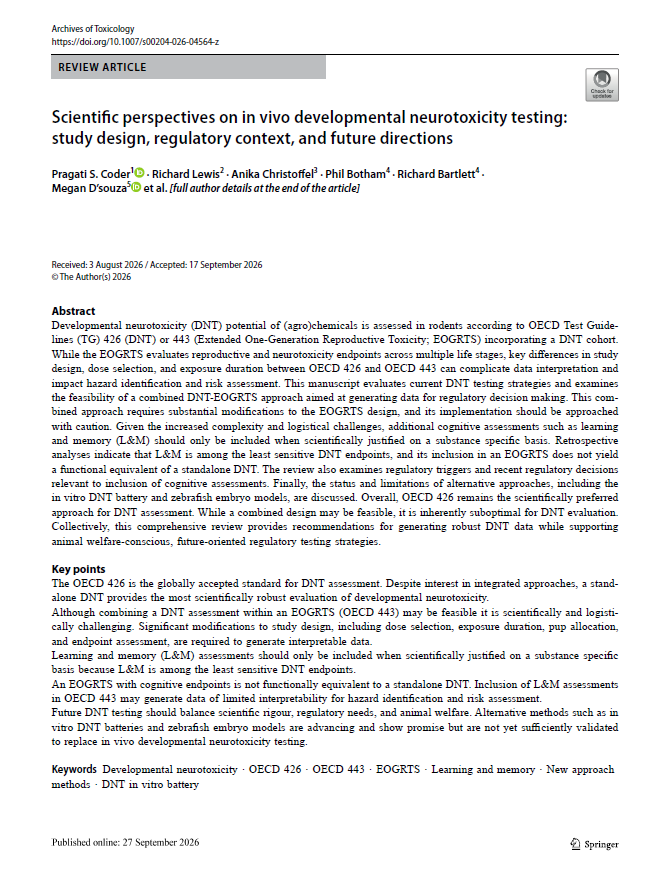
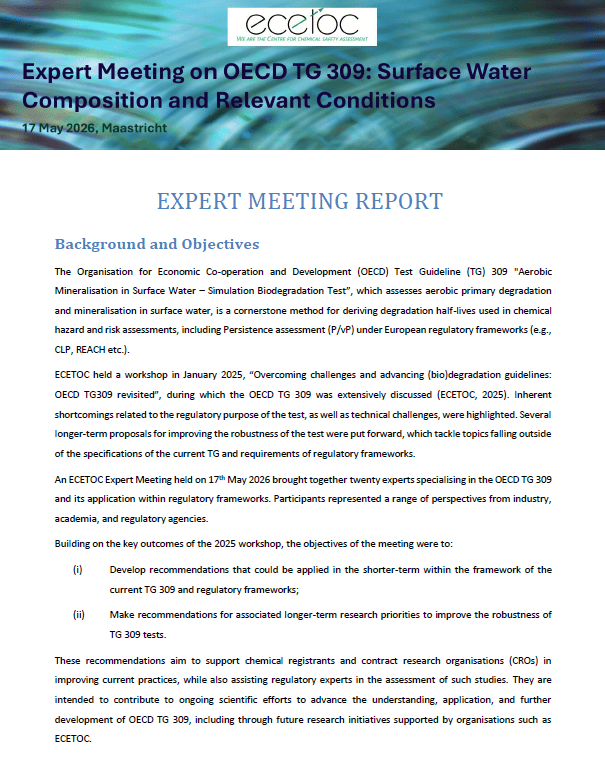







2025 Annual Report
Annual Report
ECETOC publishes a framework for the risk assessment of plastic additives
Press Release

ECETOC publishes a framework for the risk assessment of plastic additives

Part 1 sets out the fundamental elements, from problem formulation to risk characterisation.Brussels, 22 July 2026. The ECETOC Plastic Additives Task Force has published the first of two peer...
January 2026 news from the Sec Gen
News

January 2026 news from the Sec Gen

Dear colleagues and friends,As we begin a new year, I would like to thank you for your continued engagement and trust in ECETOC. 2026 promises to be an exciting and dynamic year, and I am pleased...
HSSD Tool

HSSD Tool

This software was developed by a consortium of partners to facilitate the uptake of novel approaches to estimate aquatic threshold concentrations (e.g. the concentration at which 5% of the species are exposed above their EC50, HC5).
The Human Exposure Assessment Tools Database (heatDB)

The Human Exposure Assessment Tools Database (heatDB)

heatdb is a public directory of exposure data sources as well as available tools for exposure
NanoApp

NanoApp

ECETOC’s NanoApp is a tool designed to define the boundaries of sets of similar nanoforms and to generate a justification for the REACH registration.
Targeted Risk Assessment (TRA)

Targeted Risk Assessment (TRA)

The Targeted Risk Assessment (TRA) estimates exposures to workers, consumers and the environment that arise during a series of events.
TRA Task Force – Worker branch

TRA Task Force – Worker branch

Why? The Worker TRA Task Force has been active since 2019, delivering projects that advance the scientific basis of the Worker Targeted Risk Assessment (TRA) tool. Its overarching objective is to e...
Immunotoxicity assessment: Addressing Challenges and Advancing Methodologies [Workshop → Task Force]​

Immunotoxicity assessment: Addressing Challenges and Advancing Methodologies [Workshop → Task Force]​

Why?Regulatory assessment of immunotoxic properties of chemicals is a complex and challenging task​ Limited regulatory guidance exists​ Lack of industry and regulatory knowledge​...
Chronic fish case studies towards an IATA

Chronic fish case studies towards an IATA

Why?Hazard and safety assessments for the pelagic compartment often rely on in vivo studies using a single fish species, raising ethical concerns and uncertainty in terms of extrapolation....
Article
02.03.2010

Guidance for the classification of carcinogens under the globally harmonised system of classification and labelling of chemicals (GHS)

Link to the web page of this article:
doi:10.3109/10408440903384717

Please note that for copyright reasons the Secretariat cannot send a pdf version electronically. This needs to be downloaded from the journal's website. However, printed copies are available from the Secretariat upon request.

Update September, 2010

A corrigendum note has been published in Critical Reviews in Toxicology, Vol. 40, No. 8: 758 (Sep 2010). For copyright reasons, please download the corrigendum from the CRT website direct: http://informahealthcare.com/txc where it is available with free access.Link to the web page of this article:
doi:10.3109/10408444.2010.511521
Reference

Authors : McGregor D, Boobis A, Binaglia M, Botham P, Hoffstadt L, Hubbard S, Petry T, Riley A, Schwartz D, Hennes EC.
Publisher : Critical Reviews in Toxicology 40, 3, 245-285


Find out more
http://dx.doi.org/10.3109/10408440903384717