






Welcome to Talia Neal-Walthall
390510

Welcome to Talia Neal-Walthall

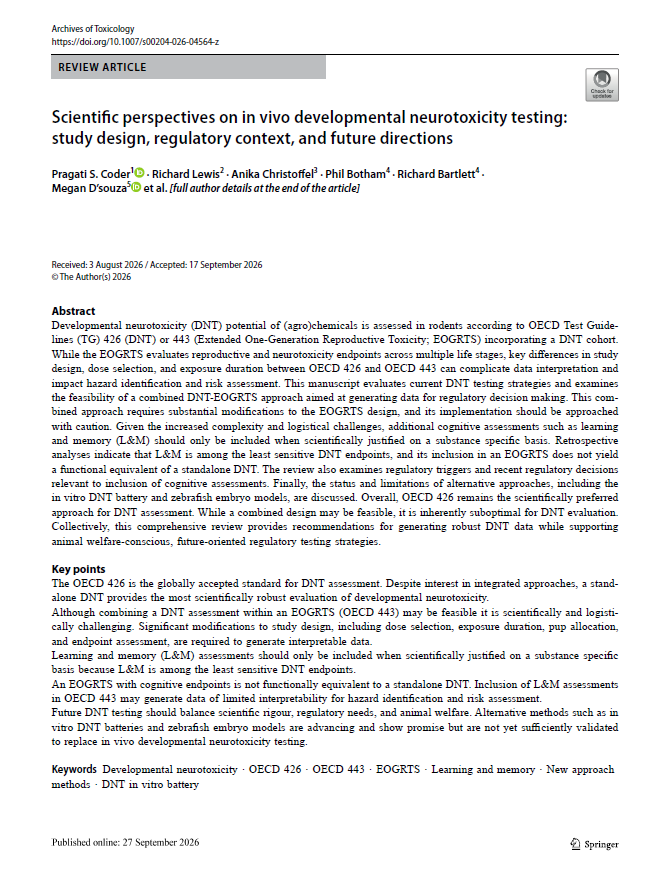
We are pleased to welcome Talia Neal-Walthall to ECETOC as a secondee. Talia joins us to work on topics related to exposure, an area central to much of our current scientific programme. She will be wi...
September 2026 news from the Sec Gen
390509

September 2026 news from the Sec Gen

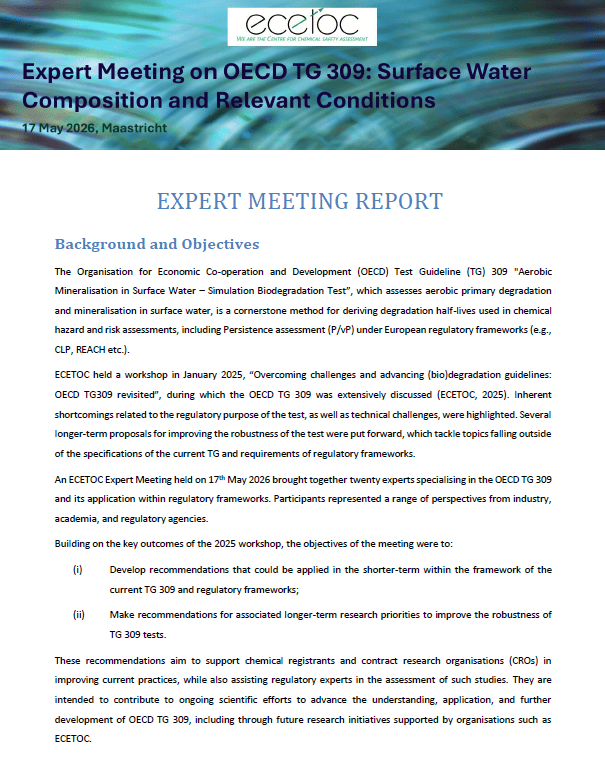
Dear members and colleagues,As we move through the year, there is a good deal to share. This has been a busy period for ECETOC, with changes to our team, our governance, and the work ahead. Let me...
HSSD Tool

HSSD Tool

This software was developed by a consortium of partners to facilitate the uptake of novel approaches to estimate aquatic threshold concentrations (e.g. the concentration at which 5% of the species are exposed above their EC50, HC5).
The Human Exposure Assessment Tools Database (heatDB)

The Human Exposure Assessment Tools Database (heatDB)

heatdb is a public directory of exposure data sources as well as available tools for exposure
NanoApp

NanoApp

ECETOC’s NanoApp is a tool designed to define the boundaries of sets of similar nanoforms and to generate a justification for the REACH registration.
Targeted Risk Assessment (TRA)

Targeted Risk Assessment (TRA)

The Targeted Risk Assessment (TRA) estimates exposures to workers, consumers and the environment that arise during a series of events.
TRA Task Force – Worker branch

TRA Task Force – Worker branch

Why? The Worker TRA Task Force has been active since 2019, delivering projects that advance the scientific basis of the Worker Targeted Risk Assessment (TRA) tool. Its overarching objective is to e...
Immunotoxicity assessment: Addressing Challenges and Advancing Methodologies [Workshop → Task Force]​

Immunotoxicity assessment: Addressing Challenges and Advancing Methodologies [Workshop → Task Force]​

Why?Regulatory assessment of immunotoxic properties of chemicals is a complex and challenging task​ Limited regulatory guidance exists​ Lack of industry and regulatory knowledge​...
Chronic fish case studies towards an IATA

Chronic fish case studies towards an IATA

Why?Hazard and safety assessments for the pelagic compartment often rely on in vivo studies using a single fish species, raising ethical concerns and uncertainty in terms of extrapolation....
28.09.2006

Winners of the ECETOC 2006 Science Award for health science related research

On the occasion of the 2006 EUROTOX (European Societies of Toxicology) Annual Congress this 20-24th September in Croatia, ECETOC was pleased to present one of its Young Scientist Awards to Sabine Langie of the University of Maastricht, The Netherlands for her poster entitled: 'Redox-dependent regulation of nucleotide excision repair'.

This project was selected for the award under the broad theme of ‘toxicological research into mechanisms and risk assessment’ and according to the following criteria:

  • originality and potential impact of the research project,
  • adequacy of the methodological approach adopted,
  • scientific value of the results,
  • as well as care, quality and clarity of the presentation.

Sabine’s research is a significant contribution to the understanding of the mechanisms of DNA repair which plays an important role in maintaining genomic integrity. She was awarded a cheque for €2,000 to put towards the development of her scientific career as well as the registration fee for next year’s EUROTOX Annual Congressm, which is offered by the organisers.

In addition, ECETOC was pleased to be able to recognise the work of Vlatka Filipovic Marijic of the Ruder Boškovic Institute, Zagreb, Croatia. Her poster, entitled ‘Metal exposure assessment in native fish, Mullus barbatus L., from the Eastern Adriatic sea’ was agreed by the judges to be ‘Highly Commended’. In her research, Vlatka looked into age-related metallothioneins and metal fluctuation in liver, kidney and intestine tissue of M.barbatus, a UNEP recommended bioindicator for the Mediterranean region. The award comprises her registration fee and expenses to attend the 2007 EUROTOX Annual Congress in Amsterdam, The Netherlands.


