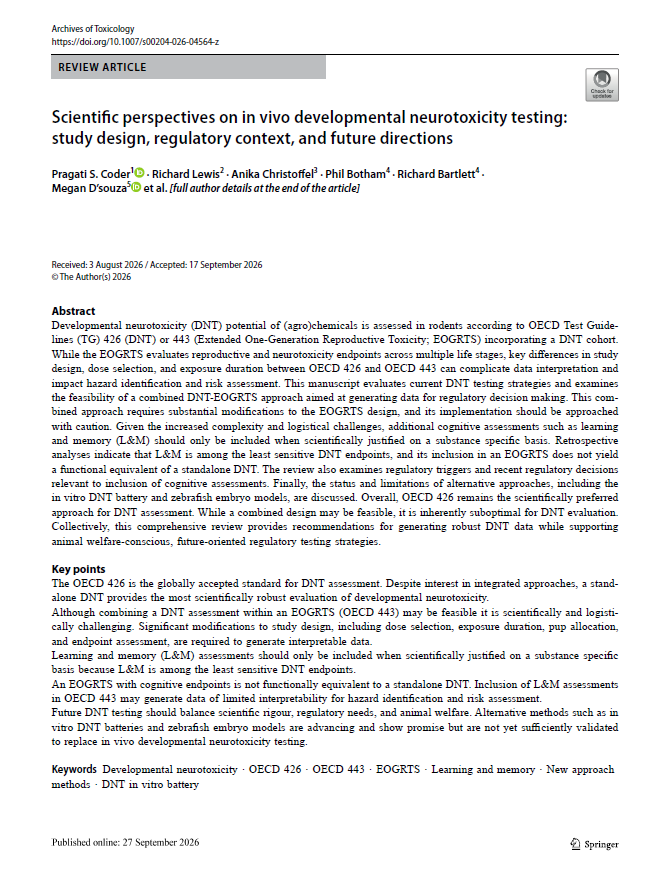






ECETOC Publication Highlights Scientific Perspectives on Developmental Neurotoxicity Testing and Future Regulatory Directions
390553

ECETOC Publication Highlights Scientific Perspectives on Developmental Neurotoxicity Testing and Future Regulatory Directions

Brussels, 1 October 2026 – ECETOC is pleased to announce the publication of a new review article in Archives of Toxicology titled “Scientific Perspectives on In Vivo Developmental Neurotoxicity T...
Welcome to Talia Neal-Walthall
390510

Welcome to Talia Neal-Walthall

We are pleased to welcome Talia Neal-Walthall to ECETOC as a secondee. Talia joins us to work on topics related to exposure, an area central to much of our current scientific programme. She will be wi...
HSSD Tool

HSSD Tool

This software was developed by a consortium of partners to facilitate the uptake of novel approaches to estimate aquatic threshold concentrations (e.g. the concentration at which 5% of the species are exposed above their EC50, HC5).
The Human Exposure Assessment Tools Database (heatDB)

The Human Exposure Assessment Tools Database (heatDB)

heatdb is a public directory of exposure data sources as well as available tools for exposure
NanoApp

NanoApp

ECETOC’s NanoApp is a tool designed to define the boundaries of sets of similar nanoforms and to generate a justification for the REACH registration.
Targeted Risk Assessment (TRA)

Targeted Risk Assessment (TRA)

The Targeted Risk Assessment (TRA) estimates exposures to workers, consumers and the environment that arise during a series of events.
TRA Task Force – Worker branch

TRA Task Force – Worker branch

Why? The Worker TRA Task Force has been active since 2019, delivering projects that advance the scientific basis of the Worker Targeted Risk Assessment (TRA) tool. Its overarching objective is to e...
Immunotoxicity assessment: Addressing Challenges and Advancing Methodologies [Workshop → Task Force]​

Immunotoxicity assessment: Addressing Challenges and Advancing Methodologies [Workshop → Task Force]​

Why?Regulatory assessment of immunotoxic properties of chemicals is a complex and challenging task​ Limited regulatory guidance exists​ Lack of industry and regulatory knowledge​...
Chronic fish case studies towards an IATA

Chronic fish case studies towards an IATA

Why?Hazard and safety assessments for the pelagic compartment often rely on in vivo studies using a single fish species, raising ethical concerns and uncertainty in terms of extrapolation....
News
12.06.2014

Publication of report on Category approaches, read-across, (Q)SAR

An accepted practice for the assessment of human health and environmental safety of chemicals is the use of models and analogues to fill data gaps for specific endpoints either for single or multiple chemicals that share structural similarities, and/or comparable reactivity or similarities in metabolism in mammals, fish and other organisms.  For example, this approach is acceptable, with limitations, in preparing dossiers for REACH, and it supports efforts for reducing animal testing.  The OECD has published guidance on the formation and use of chemical categories for data gap filling.  An ECETOC Task Force recently produced TR 109: High information content technologies in support of read-across in chemical risk assessment; a project that has highlighted methods for read-across.

With the plethora of models and guidance growing for both human health and the environment, it would be prudent to identify recommended practices.  Additionally, the 2013 and 2018 REACH deadlines are pending; these deadlines require lower volume producers and importers to submit chemical safety assessments.  A report describing recommended practices in this area would be useful in supporting industry‘s risk characterisation and prioritisation activities across all sectors. To this end, an ECETOC Task Force of industry and regulatory experts on categorisation methods, read-across and the use of (Q)SAR in risk assessment has prepared Technical Report No. 116: Category approaches, read-across, (Q)SAR.

Downloads