



2025 Annual Report
Annual Report
ECETOC publishes a framework for the risk assessment of plastic additives
Press Release

ECETOC publishes a framework for the risk assessment of plastic additives

Part 1 sets out the fundamental elements, from problem formulation to risk characterisation.Brussels, 22 July 2026. The ECETOC Plastic Additives Task Force has published the first of two peer...
January 2026 news from the Sec Gen
News

January 2026 news from the Sec Gen

Dear colleagues and friends,As we begin a new year, I would like to thank you for your continued engagement and trust in ECETOC. 2026 promises to be an exciting and dynamic year, and I am pleased...
HSSD Tool

HSSD Tool

This software was developed by a consortium of partners to facilitate the uptake of novel approaches to estimate aquatic threshold concentrations (e.g. the concentration at which 5% of the species are exposed above their EC50, HC5).
The Human Exposure Assessment Tools Database (heatDB)

The Human Exposure Assessment Tools Database (heatDB)

heatdb is a public directory of exposure data sources as well as available tools for exposure
NanoApp

NanoApp

ECETOC’s NanoApp is a tool designed to define the boundaries of sets of similar nanoforms and to generate a justification for the REACH registration.
Targeted Risk Assessment (TRA)

Targeted Risk Assessment (TRA)

The Targeted Risk Assessment (TRA) estimates exposures to workers, consumers and the environment that arise during a series of events.
Chronic fish case studies towards an IATA

Chronic fish case studies towards an IATA

Why?Hazard and safety assessments for the pelagic compartment often rely on in vivo studies using a single fish species, raising ethical concerns and uncertainty in terms of extrapolation....
Estimating the environmental release of Synthetic Polymeric Microparticles from Products

Estimating the environmental release of Synthetic Polymeric Microparticles from Products

Why?REACH restriction: SPM use restricted; emissions reporting required by May 2027. Gap: No analytical methods available to measure SPM emissions. Solution: Draft SPERC-based approac...
Case Studies on Reliability and Relevance Considerations during Validation of NAMs

Case Studies on Reliability and Relevance Considerations during Validation of NAMs

Why?Validation of NAMs is often overlooked despite its importance for regulatory use. Traditional validation methods are less suitable for NAMs, which focus on key events rather than apical...
News
05.09.2024

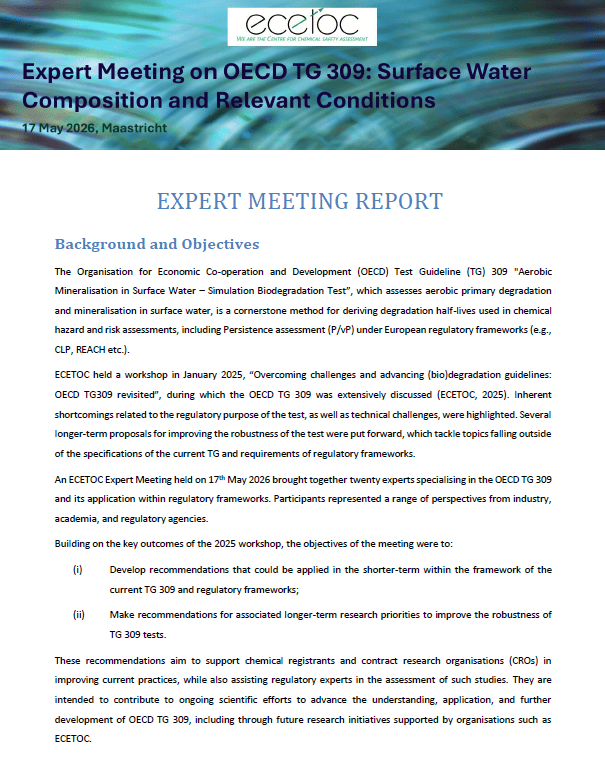
Launching Soon: Polymer Analytics Task Force

ECETOC is launching the Polymer Analytics Task Force to develop and standardize methods for analysing polymer properties essential for safety assessment. This initiative comes in response to the growing need for robust, standardized approaches to conduct proper safety assessment of polymers across various applications.

Key Focus Areas:

  • Method Development and Standardization: The Task Force will work on evaluating and developing methods for analysing critical polymer properties, such as molecular weight, oligomer content, and physical-chemical properties.
  • Support for Risk Assessment: The methods will be designed to support risk assessment and (eco-)toxicological testing, ensuring applicability across a wide range of polymer classes.
  • Guidance and Recommendations: The Task Force will provide guidance on experimental challenges and data interpretation, offering insights into partitioning coefficient determination for polymers.

Collaboration and Knowledge Sharing: The Task Force will foster collaboration between regulatory bodies, industry stakeholders, and the academic community. It will also support polymer grouping discussions by providing analytical contributions and expert consultation.

Timeline and Deliverables:

  • Duration: The Task Force will operate over the next three years, continuously adapting to regulatory developments.
  • Deliverables: Key outputs will include harmonized methods, recommendations for testing approaches, white papers, guidance notes, and the organization of workshops to gather expert feedback.

Stay tuned for further updates as we embark on this important initiative to enhance the safety and sustainability of polymers through improved analytical practices.

Interested? Contact Victor!