






Welcome to Talia Neal-Walthall
390510

Welcome to Talia Neal-Walthall

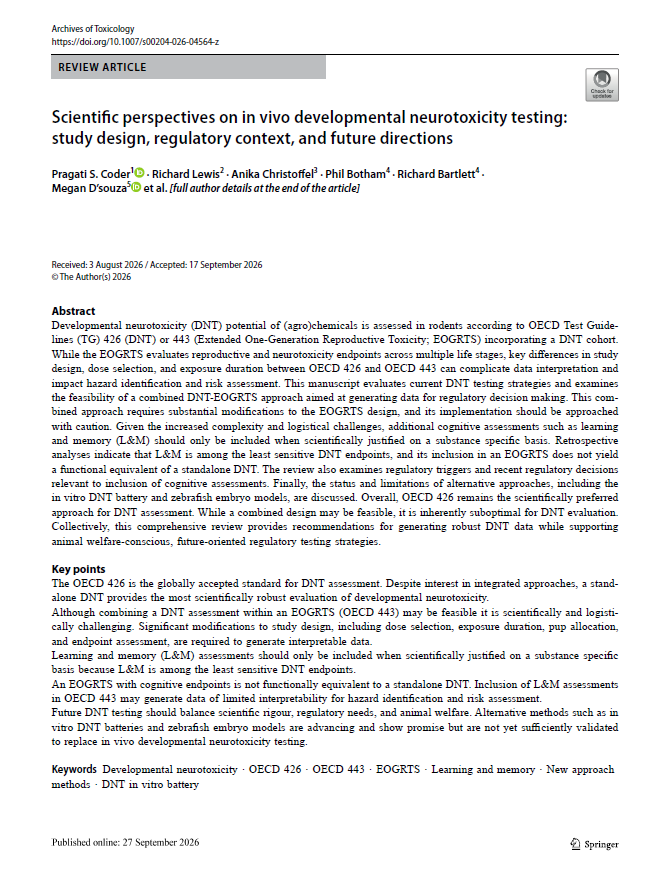
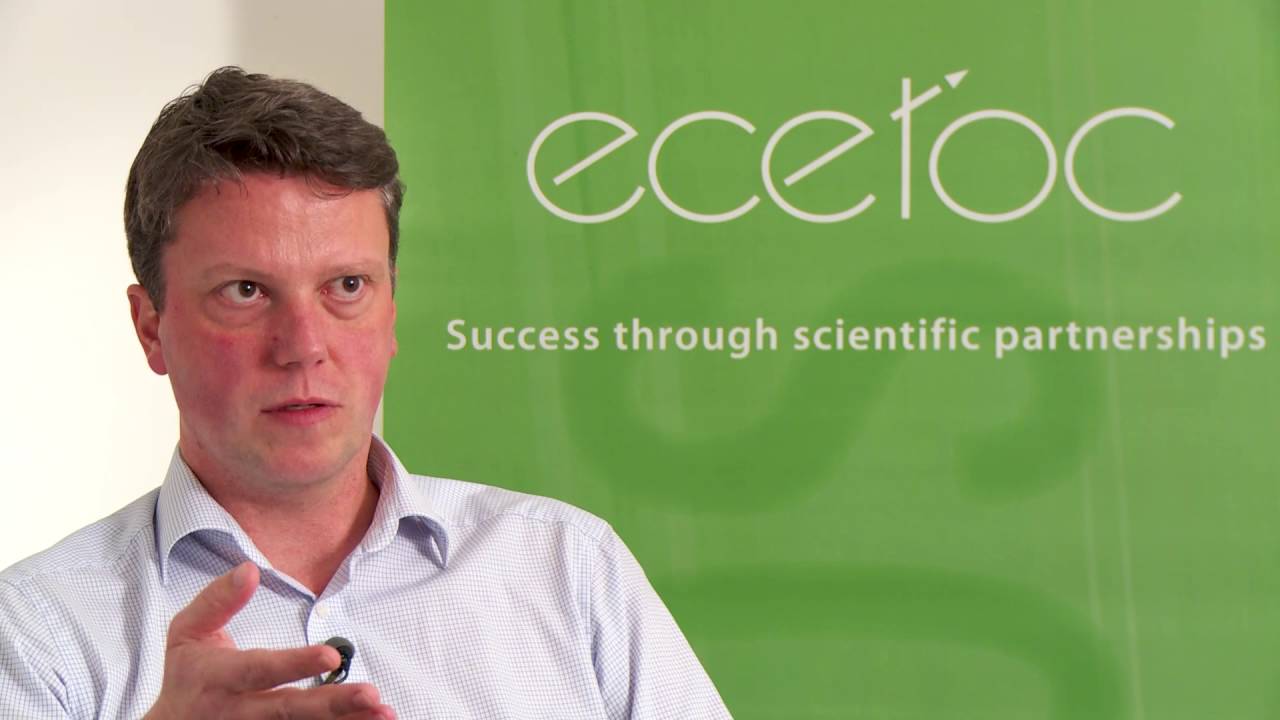
We are pleased to welcome Talia Neal-Walthall to ECETOC as a secondee. Talia joins us to work on topics related to exposure, an area central to much of our current scientific programme. She will be wi...
September 2026 news from the Sec Gen
390509

September 2026 news from the Sec Gen

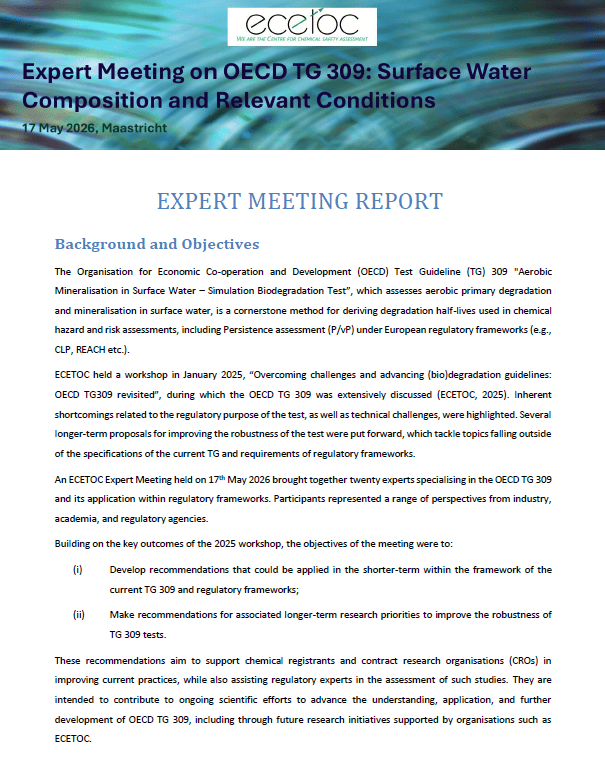
Dear members and colleagues,As we move through the year, there is a good deal to share. This has been a busy period for ECETOC, with changes to our team, our governance, and the work ahead. Let me...
HSSD Tool

HSSD Tool

This software was developed by a consortium of partners to facilitate the uptake of novel approaches to estimate aquatic threshold concentrations (e.g. the concentration at which 5% of the species are exposed above their EC50, HC5).
The Human Exposure Assessment Tools Database (heatDB)

The Human Exposure Assessment Tools Database (heatDB)

heatdb is a public directory of exposure data sources as well as available tools for exposure
NanoApp

NanoApp

ECETOC’s NanoApp is a tool designed to define the boundaries of sets of similar nanoforms and to generate a justification for the REACH registration.
Targeted Risk Assessment (TRA)

Targeted Risk Assessment (TRA)

The Targeted Risk Assessment (TRA) estimates exposures to workers, consumers and the environment that arise during a series of events.
TRA Task Force – Worker branch

TRA Task Force – Worker branch

Why? The Worker TRA Task Force has been active since 2019, delivering projects that advance the scientific basis of the Worker Targeted Risk Assessment (TRA) tool. Its overarching objective is to e...
Immunotoxicity assessment: Addressing Challenges and Advancing Methodologies [Workshop → Task Force]​

Immunotoxicity assessment: Addressing Challenges and Advancing Methodologies [Workshop → Task Force]​

Why?Regulatory assessment of immunotoxic properties of chemicals is a complex and challenging task​ Limited regulatory guidance exists​ Lack of industry and regulatory knowledge​...
Chronic fish case studies towards an IATA

Chronic fish case studies towards an IATA

Why?Hazard and safety assessments for the pelagic compartment often rely on in vivo studies using a single fish species, raising ethical concerns and uncertainty in terms of extrapolation....
Third Party News
09.03.2015

Invitation NORMAN – UBA Workshop Biocides – compartment-specific strategies – 25-26 June 2015, Berlin

Since September 2013 the assessment and authorisation of biocides on the European market have been regulated by the EU Biocidal Products Regulation No. 528/2012 (BPR). Environmental monitoring can help to assess changes caused by the implementation of the new legislation: environmental burdens may decrease because several biocidal active substances have been withdrawn from the market or will be banned in the coming years as a consequence of non-approval decisions. Additionally, the use of certain biocidal substances will be restricted by risk mitigation measures. On the other hand, environmental levels of other biocides may rise as a result of replacement for non-approved compounds.

This international workshop on biocides monitoring, jointly organised by the German Federal Environment Agency (Umweltbundesamt, www.umweltbundesamt.de) and the NORMAN network (www.normandata.eu), as a follow-up to the first joint workshop in November 2012 (see www.normandata.eu/?q=node/99), will address the role of environmental monitoring in assessing the consequences of the EU biocides regulation.

An outcome of the first workshop was the recognition of the importance of adapting biocides monitoring to the different environmental compartments. Compartment-specific strategies for biocides monitoring will therefore be the main focus of the current workshop. Dedicated sessions will cover monitoring of biocides in urban environments, in surface waters and in terrestrial ecosystems. Methodological aspects and the state of knowledge on biocide-specific monitoring in these compartments will be discussed in break-out groups.