






ECETOC Publication Highlights Scientific Perspectives on Developmental Neurotoxicity Testing and Future Regulatory Directions
390553

ECETOC Publication Highlights Scientific Perspectives on Developmental Neurotoxicity Testing and Future Regulatory Directions

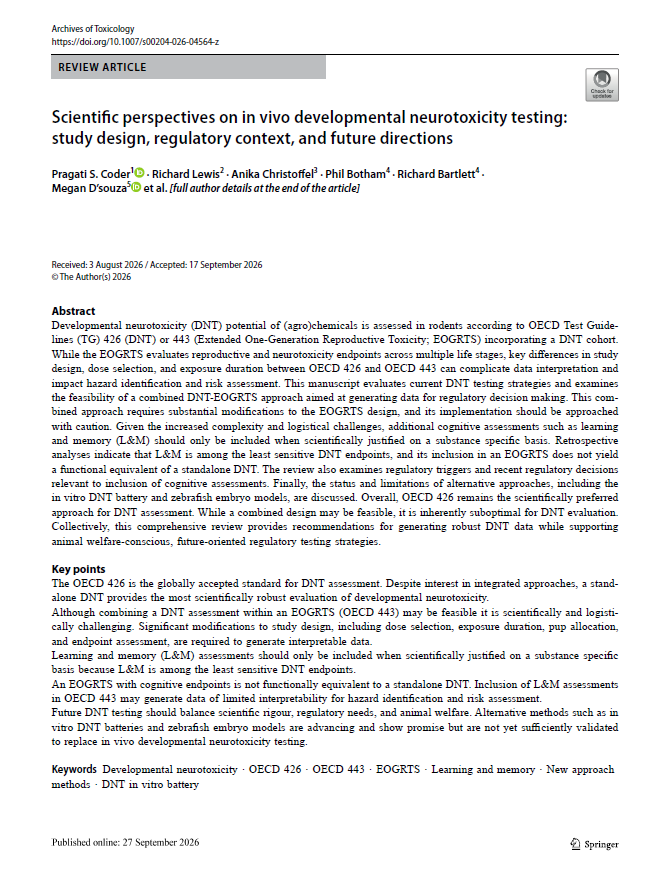
Brussels, 1 October 2026 – ECETOC is pleased to announce the publication of a new review article in Archives of Toxicology titled “Scientific Perspectives on In Vivo Developmental Neurotoxicity T...
Welcome to Talia Neal-Walthall
390510

Welcome to Talia Neal-Walthall

We are pleased to welcome Talia Neal-Walthall to ECETOC as a secondee. Talia joins us to work on topics related to exposure, an area central to much of our current scientific programme. She will be wi...
HSSD Tool

HSSD Tool

This software was developed by a consortium of partners to facilitate the uptake of novel approaches to estimate aquatic threshold concentrations (e.g. the concentration at which 5% of the species are exposed above their EC50, HC5).
The Human Exposure Assessment Tools Database (heatDB)

The Human Exposure Assessment Tools Database (heatDB)

heatdb is a public directory of exposure data sources as well as available tools for exposure
NanoApp

NanoApp

ECETOC’s NanoApp is a tool designed to define the boundaries of sets of similar nanoforms and to generate a justification for the REACH registration.
Targeted Risk Assessment (TRA)

Targeted Risk Assessment (TRA)

The Targeted Risk Assessment (TRA) estimates exposures to workers, consumers and the environment that arise during a series of events.
TRA Task Force – Worker branch

TRA Task Force – Worker branch

Why? The Worker TRA Task Force has been active since 2019, delivering projects that advance the scientific basis of the Worker Targeted Risk Assessment (TRA) tool. Its overarching objective is to e...
Immunotoxicity assessment: Addressing Challenges and Advancing Methodologies [Workshop → Task Force]​

Immunotoxicity assessment: Addressing Challenges and Advancing Methodologies [Workshop → Task Force]​

Why?Regulatory assessment of immunotoxic properties of chemicals is a complex and challenging task​ Limited regulatory guidance exists​ Lack of industry and regulatory knowledge​...
Chronic fish case studies towards an IATA

Chronic fish case studies towards an IATA

Why?Hazard and safety assessments for the pelagic compartment often rely on in vivo studies using a single fish species, raising ethical concerns and uncertainty in terms of extrapolation....
Event
06.03.2013

ECETOC Task Force on Poorly Soluble Particle / Lung Overload meeting

When Wednesday, 6 Mar 2013

Where ECETOC Offices, Brussels, Belgium (map)

Description 

Meeting for task force members only

The majority of data on respiratory effects of inhaled poorly soluble particles (PSP) stems from rat inhalation studies. This relates to the rat-specific effect pattern of 'lung overload' for the inhalation toxicity of PSP. The relevance of the rat as a model for the assessment of repeated exposure to PSP for humans has been questioned by a number of analyses since the rat was shown to be particular sensitive towards these effects compared to other rodents, non-human primates and humans. The last comprehensive review was developed in the year 2000 by the ILSI Risk Sciences Institute. Although the 'lung overload' phenomena is known for a long time, it has recently become more prominent for the derivation of DNEL under REACH registrations, setting of exposure limits, and for classification and labelling under the Globally Harmonized System of Classification and Labelling of Chemicals (GHS) . The United Nations Sub-Committee of Experts on GHS in 2009 requested further input has been requested from industry.