








![Immunotoxicity assessment: Addressing Challenges and Advancing Methodologies [Workshop → Task Force]](https://www.ecetoc.org/wp-content/uploads/2026/07/Picture2-1024x923.jpg)



ECETOC publishes a framework for the risk assessment of plastic additives
Part 1 sets out the fundamental elements, from problem formulation to risk characterisation.
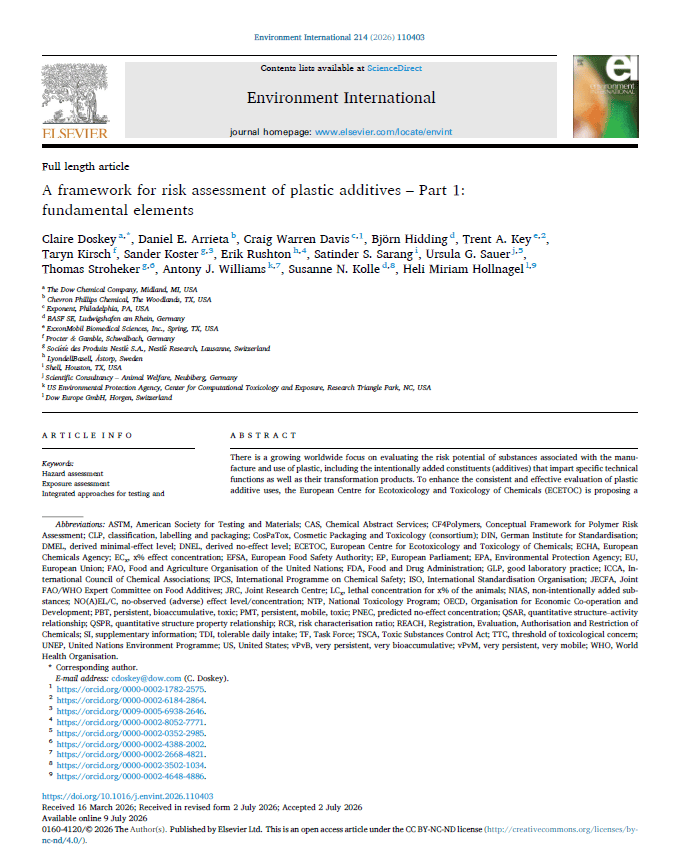
Brussels, 22 July 2026. The ECETOC Plastic Additives Task Force has published the first of two peer reviewed articles in Environment International. The article is open access.
Additives are already assessed under REACH and under sector specific rules for food contact materials, medical devices and toys. What is missing is a consistent approach for the later stages of the life cycle, when articles are recycled, reused or disposed of. Most regulations stop at the end of the original intended use.
The framework addresses that gap. It follows the risk assessment paradigm of the WHO International Programme on Chemical Safety and builds on ECETOC’s Conceptual Framework for Polymer Risk Assessment. It is comprised of five modules: problem formulation and initial prioritisation, retrieval and evaluation of available information, higher tier exposure assessment, higher tier hazard assessment, and risk characterisation. The modules are pursued in an iterative, circular manner, and the assessment stops as soon as a risk potential can be excluded or the risks identified can be characterised and managed.
Two features are worth noting. The approach is risk based rather than hazard based, so migration from the plastic matrix is quantified rather than assumed. It also includes a transparent scoring scheme for prioritising additive and use combinations when there are too many to assess at once, with six worked examples. The article further reviews the databases, in silico models and test methods currently available to assessors.
A second article is in preparation. It will cover complex scenarios, including mixed recycling streams, mixed additive inventories and transformation products.
“Risk assessment principles for plastic additives already exist. What the Task Force has done is set them out in one structured sequence, so that assessors know what information to gather, in what order, and when the assessment can be concluded.” Claire Doskey, lead author and member of the ECETOC Plastic Additives Task Force.
Reference
Doskey C et al. A framework for risk assessment of plastic additives, part 1: fundamental elements. Environment International, Volume 214, August 2026, Article 110403. Open access.