






2025 Annual Report
Annual Report
ECETOC publishes a framework for the risk assessment of plastic additives
Press Release

ECETOC publishes a framework for the risk assessment of plastic additives

Part 1 sets out the fundamental elements, from problem formulation to risk characterisation.Brussels, 22 July 2026. The ECETOC Plastic Additives Task Force has published the first of two peer...
January 2026 news from the Sec Gen
News

January 2026 news from the Sec Gen

Dear colleagues and friends,As we begin a new year, I would like to thank you for your continued engagement and trust in ECETOC. 2026 promises to be an exciting and dynamic year, and I am pleased...
HSSD Tool

HSSD Tool

This software was developed by a consortium of partners to facilitate the uptake of novel approaches to estimate aquatic threshold concentrations (e.g. the concentration at which 5% of the species are exposed above their EC50, HC5).
The Human Exposure Assessment Tools Database (heatDB)

The Human Exposure Assessment Tools Database (heatDB)

heatdb is a public directory of exposure data sources as well as available tools for exposure
NanoApp

NanoApp

ECETOC’s NanoApp is a tool designed to define the boundaries of sets of similar nanoforms and to generate a justification for the REACH registration.
Targeted Risk Assessment (TRA)

Targeted Risk Assessment (TRA)

The Targeted Risk Assessment (TRA) estimates exposures to workers, consumers and the environment that arise during a series of events.
TRA Task Force – Worker branch

TRA Task Force – Worker branch

Why? The Worker TRA Task Force has been active since 2019, delivering projects that advance the scientific basis of the Worker Targeted Risk Assessment (TRA) tool. Its overarching objective is to e...
Immunotoxicity assessment: Addressing Challenges and Advancing Methodologies [Workshop → Task Force]​

Immunotoxicity assessment: Addressing Challenges and Advancing Methodologies [Workshop → Task Force]​

Why?Regulatory assessment of immunotoxic properties of chemicals is a complex and challenging task​ Limited regulatory guidance exists​ Lack of industry and regulatory knowledge​...
Chronic fish case studies towards an IATA

Chronic fish case studies towards an IATA

Why?Hazard and safety assessments for the pelagic compartment often rely on in vivo studies using a single fish species, raising ethical concerns and uncertainty in terms of extrapolation....
Article
26.08.2014

Incorporating potency into EU classification for carcinogenicity and reproductive toxicity

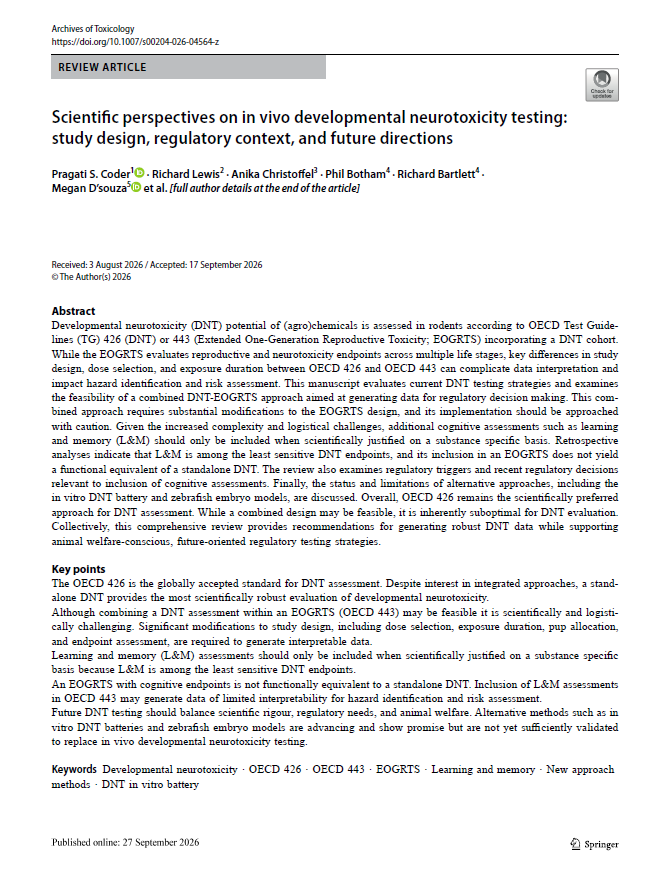
Although risk assessment, assessing the potential harm of each particular exposure of a substance, is desirable, it is not feasible in many situations. Risk assessment uses a process of hazard identification, hazard characterisation, and exposure assessment as its components. In the absence of risk assessment, the purpose of classification is to give broad guidance (through the label) on the suitability of a chemical in a range of use situations. Hazard classification in the EU is a process involving identification of the hazards of a substance, followed by comparison of those hazards (including degree of hazard) with defined criteria. Classification should therefore give guidance on degree of hazard as well as hazard identification. Potency is the most important indicator of degree of hazard and should therefore be included in classification. This is done for acute lethality and general toxicity by classifying on dose required to cause the effect. The classification in the EU for carcinogenicity and reproductive toxicity does not discriminate across the wide range of potencies seen (6 orders of magnitude) for carcinogenicity and for developmental toxicity and fertility. Therefore potency should be included in the classification process. The methodology in the EU guidelines for classification for deriving specific concentration limits is a rigorous process for assigning substances which cause tumours or developmental toxicity and infertility in experimental animals to high, medium or low degree of hazard categories by incorporating potency. Methods are suggested on how the degree of hazard so derived could be used in the EU classification process to improve hazard communication and in downstream risk management.

Please note that the download link leads to the publisher's website for free download of this Open Access article.
In a nutshell
Classification should give guidance on the potential hazards of chemicals. Once the nature of the hazard is known, potency is the most important indicator of the degree of the hazard. Classification for carcinogenicity and reproductive toxicity does not distinguish between chemicals with up to 7 orders of magnitude difference in potency.  This can cause problems in communication and has downstream consequences for the use of chemicals which may be inappropriate.  There is methodology in the EU guidelines for assessing potency which is scientifically valid and should be used more widely. Classification schemes which incorporate potency have been developed.  These would promote clarity of communication and more relevant downstream risk management for chemicals. It is hoped this work will start a discussion on changing the GHS criteria.
This Open Access article is available via http://bit.ly/ecetoc-art2014-Hennes-et-al
Download this newsflash in PDF format:
Reference

Authors: Hennes C, Batke M, Bomann W, Duhayon S, Kosemund K, Politano V, Stinchcombe S, Doe J

Hennes C, Batke M, Bomann W, Duhayon S, Kosemund K, Politano V, Stinchcombe S, Doe J. 2014. Incorporating potency into EU classification for carcinogenicity and reproductive toxicity.
Accepted for publication in Regulatory Toxicology & Pharmacology
doi: 10.1016/j.yrtph.2014.07.022  [Epub ahead of print]

Find out more
http://www.sciencedirect.com/science/article/pii/S0273230014001779