










ECETOC Publication Highlights Scientific Perspectives on Developmental Neurotoxicity Testing and Future Regulatory Directions
390553

ECETOC Publication Highlights Scientific Perspectives on Developmental Neurotoxicity Testing and Future Regulatory Directions

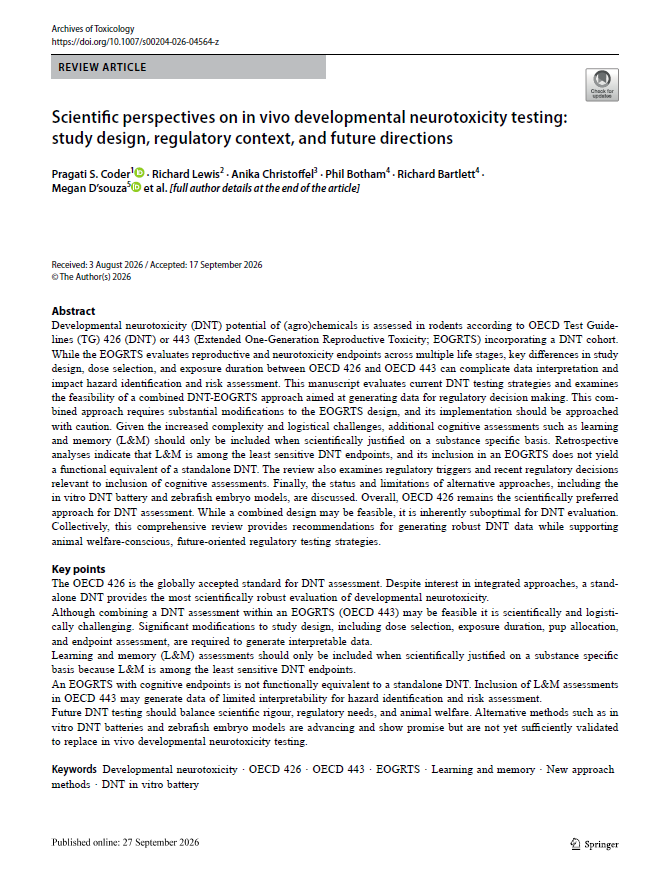
Brussels, 1 October 2026 – ECETOC is pleased to announce the publication of a new review article in Archives of Toxicology titled “Scientific Perspectives on In Vivo Developmental Neurotoxicity T...
Welcome to Talia Neal-Walthall
390510

Welcome to Talia Neal-Walthall

We are pleased to welcome Talia Neal-Walthall to ECETOC as a secondee. Talia joins us to work on topics related to exposure, an area central to much of our current scientific programme. She will be wi...
HSSD Tool

HSSD Tool

This software was developed by a consortium of partners to facilitate the uptake of novel approaches to estimate aquatic threshold concentrations (e.g. the concentration at which 5% of the species are exposed above their EC50, HC5).
The Human Exposure Assessment Tools Database (heatDB)

The Human Exposure Assessment Tools Database (heatDB)

heatdb is a public directory of exposure data sources as well as available tools for exposure
NanoApp

NanoApp

ECETOC’s NanoApp is a tool designed to define the boundaries of sets of similar nanoforms and to generate a justification for the REACH registration.
Targeted Risk Assessment (TRA)

Targeted Risk Assessment (TRA)

The Targeted Risk Assessment (TRA) estimates exposures to workers, consumers and the environment that arise during a series of events.
TRA Task Force – Worker branch

TRA Task Force – Worker branch

Why? The Worker TRA Task Force has been active since 2019, delivering projects that advance the scientific basis of the Worker Targeted Risk Assessment (TRA) tool. Its overarching objective is to e...
Immunotoxicity assessment: Addressing Challenges and Advancing Methodologies [Workshop → Task Force]​

Immunotoxicity assessment: Addressing Challenges and Advancing Methodologies [Workshop → Task Force]​

Why?Regulatory assessment of immunotoxic properties of chemicals is a complex and challenging task​ Limited regulatory guidance exists​ Lack of industry and regulatory knowledge​...
Chronic fish case studies towards an IATA

Chronic fish case studies towards an IATA

Why?Hazard and safety assessments for the pelagic compartment often rely on in vivo studies using a single fish species, raising ethical concerns and uncertainty in terms of extrapolation....
Technical Report
29.12.2002

TR 085 – Recognition of, and Differentiation between, Adverse and Non-adverse Effects in Toxicology Studies

TR 085 : Recognition of, and Differentiation between, Adverse and Non-adverse Effects in Toxicology Studies | December 2002

This report proposes a structured approach to assist the toxicologist in arriving at consistent study interpretation. There are two main steps to the approach, and for each step, criteria are described that form the basis of consistent judgements:

First a decision has to be made on whether differences from control values are treatment-related effects, or occur by chance. This involves consideration of such parameters as dose response, spurious measurements in individual parameters, the precision of the measurement under evaluation, ranges of natural variation and the overall biological plausibility of the observation.

Those differences judged to be treatment-related effects are then evaluated further, to differentiate between those that are adverse and those that are not. This second step involves consideration of whether the effect is an adaptive response, whether it is transient, the magnitude of the effect, its association with effects in other related endpoints, whether it is a precursor to a more significant effect, whether it has an effect on the overall function of the organism, whether it is a specific effect on an organ or organ system or secondary to general toxicity or whether the effect is a predictable consequence of the experimental model.

To arrive at an overall judgement in the interpretation of complex studies, it is important to apply a 'weight of evidence' approach that takes into account the criteria proposed in this report. The use of the structured scheme will contribute to improved consistency of individual study interpretation that is the foundation of reliable prediction of chemical hazard and risk.

Finally, a standard set of definitions is proposed for the key terms such as NOEL and NOAEL that are frequently used to describe the overall outcome of a toxicity study.