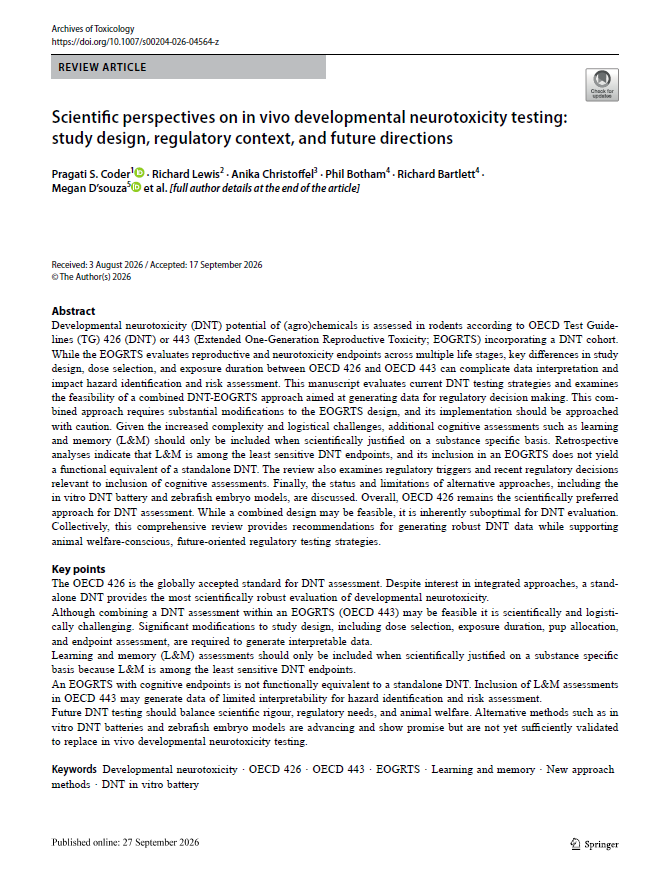











ECETOC Publication Highlights Scientific Perspectives on Developmental Neurotoxicity Testing and Future Regulatory Directions
390553

ECETOC Publication Highlights Scientific Perspectives on Developmental Neurotoxicity Testing and Future Regulatory Directions

Brussels, 1 October 2026 – ECETOC is pleased to announce the publication of a new review article in Archives of Toxicology titled “Scientific Perspectives on In Vivo Developmental Neurotoxicity T...
Welcome to Talia Neal-Walthall
390510

Welcome to Talia Neal-Walthall

We are pleased to welcome Talia Neal-Walthall to ECETOC as a secondee. Talia joins us to work on topics related to exposure, an area central to much of our current scientific programme. She will be wi...
HSSD Tool

HSSD Tool

This software was developed by a consortium of partners to facilitate the uptake of novel approaches to estimate aquatic threshold concentrations (e.g. the concentration at which 5% of the species are exposed above their EC50, HC5).
The Human Exposure Assessment Tools Database (heatDB)

The Human Exposure Assessment Tools Database (heatDB)

heatdb is a public directory of exposure data sources as well as available tools for exposure
NanoApp

NanoApp

ECETOC’s NanoApp is a tool designed to define the boundaries of sets of similar nanoforms and to generate a justification for the REACH registration.
Targeted Risk Assessment (TRA)

Targeted Risk Assessment (TRA)

The Targeted Risk Assessment (TRA) estimates exposures to workers, consumers and the environment that arise during a series of events.
TRA Task Force – Worker branch

TRA Task Force – Worker branch

Why? The Worker TRA Task Force has been active since 2019, delivering projects that advance the scientific basis of the Worker Targeted Risk Assessment (TRA) tool. Its overarching objective is to e...
Immunotoxicity assessment: Addressing Challenges and Advancing Methodologies [Workshop → Task Force]​

Immunotoxicity assessment: Addressing Challenges and Advancing Methodologies [Workshop → Task Force]​

Why?Regulatory assessment of immunotoxic properties of chemicals is a complex and challenging task​ Limited regulatory guidance exists​ Lack of industry and regulatory knowledge​...
Chronic fish case studies towards an IATA

Chronic fish case studies towards an IATA

Why?Hazard and safety assessments for the pelagic compartment often rely on in vivo studies using a single fish species, raising ethical concerns and uncertainty in terms of extrapolation....
Workshop Report
28.11.2007

Workshop Report 09 – Workshop on the Refinement of Mutagenicity / Genotoxicity Testing

WR 09 : Workshop on the Refinement of Mutagenicity / Genotoxicity Testing | November 2007

A workshop was convened by ECETOC to review current principles and methods of in vitro testing for mutagenicity and genotoxicity to identify areas for refinements and where there is scope for application of new methodologies. Currently, in vitrotests can show positive results with chemicals that are subsequently found to be negative in in vivo studies. This presents a considerable problem as the use of in vivo studies for safety testing of chemicals will be increasingly challenged under the new European chemicals legislation, REACh, and the 7th Amendment to the Cosmetics Directive precludes the use of animal testing. Thus, alternative testing strategies are being sought for all toxicological endpoints, including mutagenicity and genotoxicity. This has been made a topic under the Cefic Long-range Research Initiative which sponsored this meeting.

It was agreed that current in vitro testing methods were effective in detecting genotoxic carcinogens, albeit with some false positive findings. Non-genotoxic carcinogens are only poorly detected in these tests, and safety testing would benefit from introducing new methods. Emerging technologies and non-standard materials also require refined testing methods. Work groups evaluated new methods which use modified cells and human-specific metabolic activation systems. Furthermore, methodologies applying systems biology such as genomic technologies were considered. Related aspects were also raised including a better understanding of the role of population polymorphisms on susceptibility to carcinogens and the value of DNA-adduct biomarkers. The workshop identified areas where new improved methods are required and made some specific recommendations for future research on method development which are documented in this report.