



ECETOC Publication Highlights Scientific Perspectives on Developmental Neurotoxicity Testing and Future Regulatory Directions
390553

ECETOC Publication Highlights Scientific Perspectives on Developmental Neurotoxicity Testing and Future Regulatory Directions

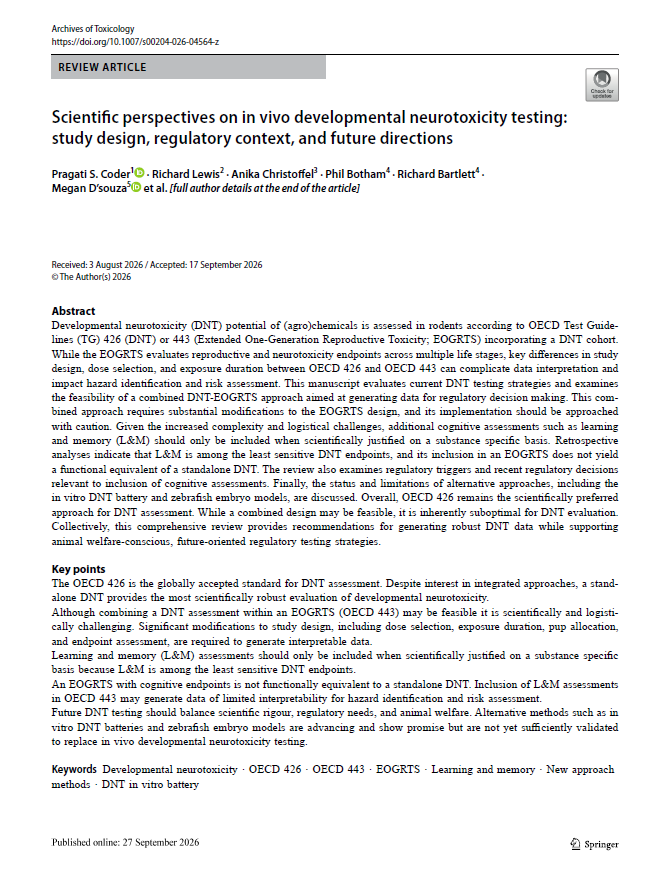
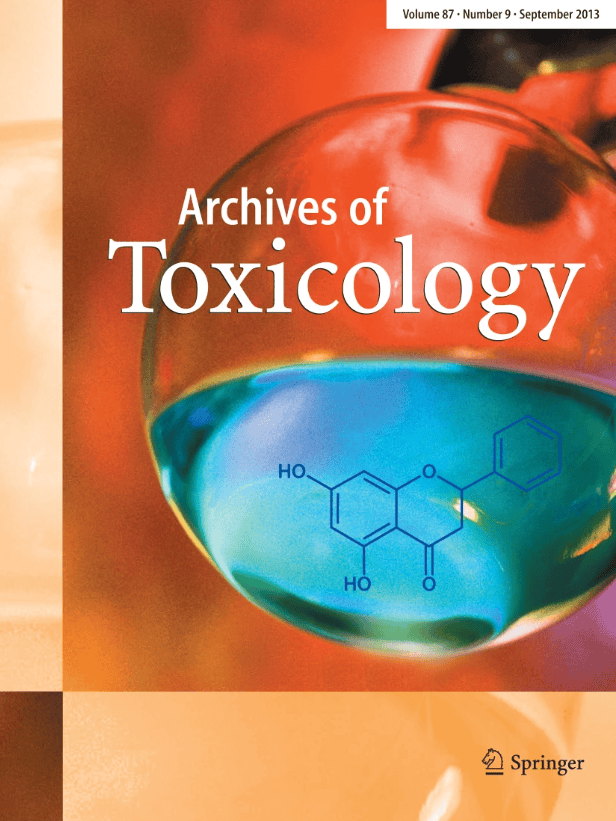
Brussels, 1 October 2026 – ECETOC is pleased to announce the publication of a new review article in Archives of Toxicology titled “Scientific Perspectives on In Vivo Developmental Neurotoxicity T...
Welcome to Talia Neal-Walthall
390510

Welcome to Talia Neal-Walthall

We are pleased to welcome Talia Neal-Walthall to ECETOC as a secondee. Talia joins us to work on topics related to exposure, an area central to much of our current scientific programme. She will be wi...
HSSD Tool

HSSD Tool

This software was developed by a consortium of partners to facilitate the uptake of novel approaches to estimate aquatic threshold concentrations (e.g. the concentration at which 5% of the species are exposed above their EC50, HC5).
The Human Exposure Assessment Tools Database (heatDB)

The Human Exposure Assessment Tools Database (heatDB)

heatdb is a public directory of exposure data sources as well as available tools for exposure
NanoApp

NanoApp

ECETOC’s NanoApp is a tool designed to define the boundaries of sets of similar nanoforms and to generate a justification for the REACH registration.
Targeted Risk Assessment (TRA)

Targeted Risk Assessment (TRA)

The Targeted Risk Assessment (TRA) estimates exposures to workers, consumers and the environment that arise during a series of events.
TRA Task Force – Worker branch

TRA Task Force – Worker branch

Why? The Worker TRA Task Force has been active since 2019, delivering projects that advance the scientific basis of the Worker Targeted Risk Assessment (TRA) tool. Its overarching objective is to e...
Immunotoxicity assessment: Addressing Challenges and Advancing Methodologies [Workshop → Task Force]​

Immunotoxicity assessment: Addressing Challenges and Advancing Methodologies [Workshop → Task Force]​

Why?Regulatory assessment of immunotoxic properties of chemicals is a complex and challenging task​ Limited regulatory guidance exists​ Lack of industry and regulatory knowledge​...
Chronic fish case studies towards an IATA

Chronic fish case studies towards an IATA

Why?Hazard and safety assessments for the pelagic compartment often rely on in vivo studies using a single fish species, raising ethical concerns and uncertainty in terms of extrapolation....
Document
27.04.2001

DOC 042 – Genomics, Transcript Profiling, Proteomics and Metabonomics (GTPM) An Introduction

DOC 042 : Genomics, transcript profiling (transcriptomics), proteomics and metabonomics (GTMP). An introduction | April 2001

Genomics, transcript profiling (transcriptomics), proteomics and metabonomics (GTMP) are rapidly developing technologies that enable researchers to study and describe biological events at the level of genetic material (genomics) and its expression in organisms. Expression can be studied at the stage of transfer of genetic information (transcriptomics), at the stage of formation of proteins (proteomics), and by determining the metabolites resulting from the activities of those proteins (metabonomics). Most of the techniques themselves are not new, but can now be applied in such a way that massive amounts of data can be generated, characterising changes in the presence and amounts of potentially thousands of biomolecules simultaneously.    GTPM offers exciting possibilities for research in biology, pharmacology and toxicology and various economically interesting applications in industry are already under development or even actively employed.    There is, on the other hand, the real danger that indiscriminate application of these technologies will lead to the generation of misleading data. Furthermore, the current (relative) lack of reference data could easily lead to mis- or over-interpretation and subsequently to undue concern by regulatory agencies. Therefore, there is an urgent need for the chemical industry as a whole to collaborate with academia and regulators in the development and sharing of such reference data sets. This will help to ensure that the new technologies are wisely applied and that agreement is reached on the appropriate interpretation of the data that they generate.