






ECETOC Publication Highlights Scientific Perspectives on Developmental Neurotoxicity Testing and Future Regulatory Directions
390553

ECETOC Publication Highlights Scientific Perspectives on Developmental Neurotoxicity Testing and Future Regulatory Directions

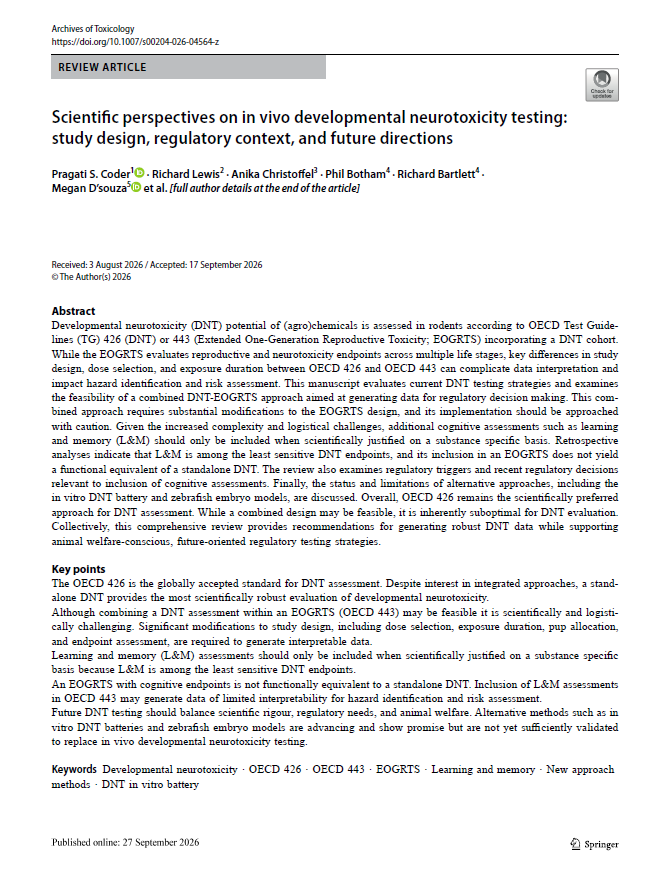
Brussels, 1 October 2026 – ECETOC is pleased to announce the publication of a new review article in Archives of Toxicology titled “Scientific Perspectives on In Vivo Developmental Neurotoxicity T...
Welcome to Talia Neal-Walthall
390510

Welcome to Talia Neal-Walthall

We are pleased to welcome Talia Neal-Walthall to ECETOC as a secondee. Talia joins us to work on topics related to exposure, an area central to much of our current scientific programme. She will be wi...
HSSD Tool

HSSD Tool

This software was developed by a consortium of partners to facilitate the uptake of novel approaches to estimate aquatic threshold concentrations (e.g. the concentration at which 5% of the species are exposed above their EC50, HC5).
The Human Exposure Assessment Tools Database (heatDB)

The Human Exposure Assessment Tools Database (heatDB)

heatdb is a public directory of exposure data sources as well as available tools for exposure
NanoApp

NanoApp

ECETOC’s NanoApp is a tool designed to define the boundaries of sets of similar nanoforms and to generate a justification for the REACH registration.
Targeted Risk Assessment (TRA)

Targeted Risk Assessment (TRA)

The Targeted Risk Assessment (TRA) estimates exposures to workers, consumers and the environment that arise during a series of events.
TRA Task Force – Worker branch

TRA Task Force – Worker branch

Why? The Worker TRA Task Force has been active since 2019, delivering projects that advance the scientific basis of the Worker Targeted Risk Assessment (TRA) tool. Its overarching objective is to e...
Immunotoxicity assessment: Addressing Challenges and Advancing Methodologies [Workshop → Task Force]​

Immunotoxicity assessment: Addressing Challenges and Advancing Methodologies [Workshop → Task Force]​

Why?Regulatory assessment of immunotoxic properties of chemicals is a complex and challenging task​ Limited regulatory guidance exists​ Lack of industry and regulatory knowledge​...
Chronic fish case studies towards an IATA

Chronic fish case studies towards an IATA

Why?Hazard and safety assessments for the pelagic compartment often rely on in vivo studies using a single fish species, raising ethical concerns and uncertainty in terms of extrapolation....
News
12.05.2020

ECETOC Task Force explores strategies for assessing effects of chemical mixtures on aquatic communities

A study by ECETOC has explored the challenge of assessing the effects of mixtures of chemicals on aquatic communities comprising many species.

Chemical safety assessment generally studies the effects of a single substance on a single species. In the real environment, however, the situation is much more complex and assessing the potential effects of mixtures of chemicals on communities of different aquatic species can result in an almost infinite number of chemical and ecological interactions and combinations.

Not all combinations of the factors involved will be found in nature. For example, certain species compositions will only be found under specific environmental conditions. It is therefore not necessarily informative or efficient to consider all these theoretical combinations in mixture toxicity testing. A sensible first step is therefore to focus on the scenarios that are most frequently encountered.

The Task Force’s report presents an overview of the different modelling approaches, evaluating their advantages and disadvantages, from effects at the individual species level through to populations, communities and ecosystems.  It then proposes a strategy for studying mixture effects that is based on (1) chemical classification; (2) ecological scenarios; and (3) model-aided synthesis and design of informative experimenting. For underpinning the workability of the strategy, a research agenda is outlined which can then feed into an intelligent experimental design of mixture studies that focuses on testing key assumptions and predictions of the models.