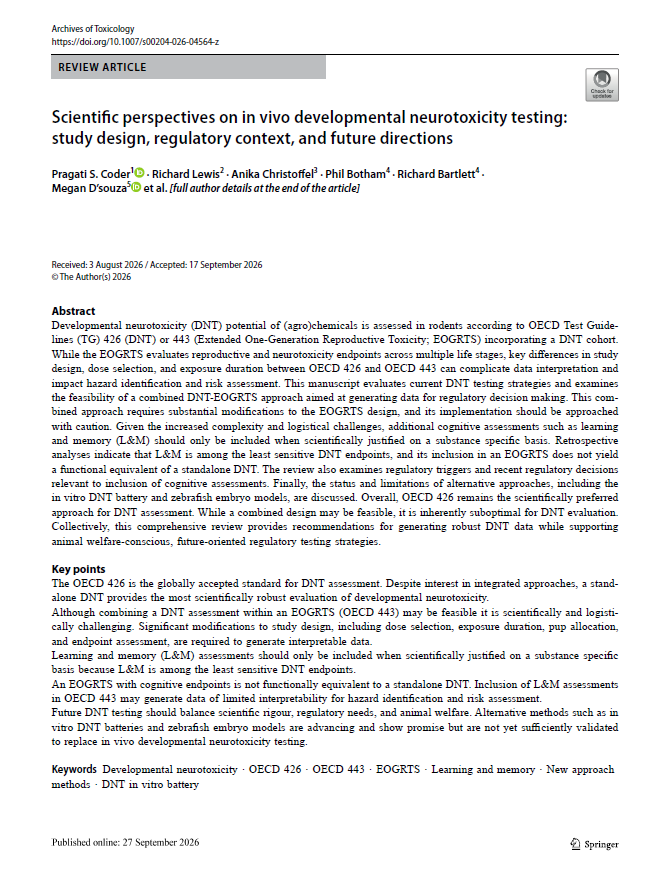
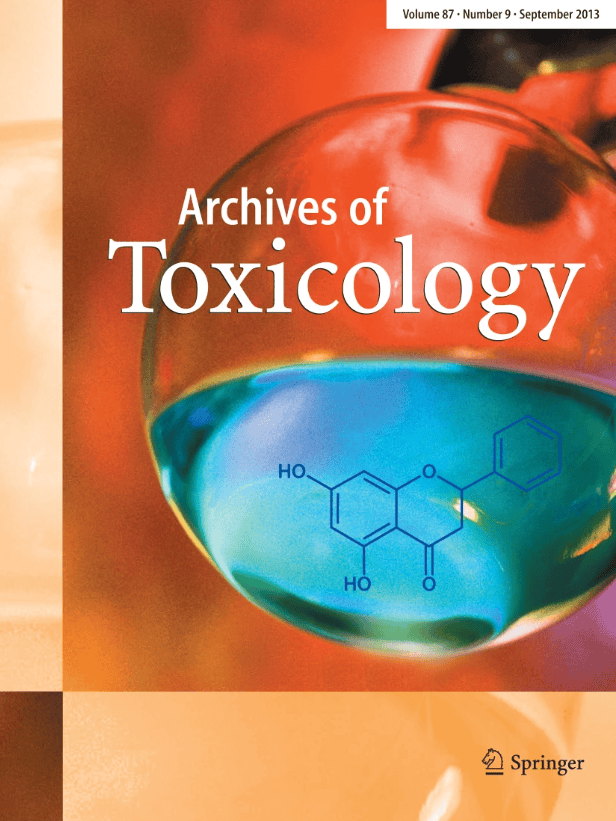






ECETOC Publication Highlights Scientific Perspectives on Developmental Neurotoxicity Testing and Future Regulatory Directions
390553

ECETOC Publication Highlights Scientific Perspectives on Developmental Neurotoxicity Testing and Future Regulatory Directions

Brussels, 1 October 2026 – ECETOC is pleased to announce the publication of a new review article in Archives of Toxicology titled “Scientific Perspectives on In Vivo Developmental Neurotoxicity T...
Welcome to Talia Neal-Walthall
390510

Welcome to Talia Neal-Walthall

We are pleased to welcome Talia Neal-Walthall to ECETOC as a secondee. Talia joins us to work on topics related to exposure, an area central to much of our current scientific programme. She will be wi...
HSSD Tool

HSSD Tool

This software was developed by a consortium of partners to facilitate the uptake of novel approaches to estimate aquatic threshold concentrations (e.g. the concentration at which 5% of the species are exposed above their EC50, HC5).
The Human Exposure Assessment Tools Database (heatDB)

The Human Exposure Assessment Tools Database (heatDB)

heatdb is a public directory of exposure data sources as well as available tools for exposure
NanoApp

NanoApp

ECETOC’s NanoApp is a tool designed to define the boundaries of sets of similar nanoforms and to generate a justification for the REACH registration.
Targeted Risk Assessment (TRA)

Targeted Risk Assessment (TRA)

The Targeted Risk Assessment (TRA) estimates exposures to workers, consumers and the environment that arise during a series of events.
TRA Task Force – Worker branch

TRA Task Force – Worker branch

Why? The Worker TRA Task Force has been active since 2019, delivering projects that advance the scientific basis of the Worker Targeted Risk Assessment (TRA) tool. Its overarching objective is to e...
Immunotoxicity assessment: Addressing Challenges and Advancing Methodologies [Workshop → Task Force]​

Immunotoxicity assessment: Addressing Challenges and Advancing Methodologies [Workshop → Task Force]​

Why?Regulatory assessment of immunotoxic properties of chemicals is a complex and challenging task​ Limited regulatory guidance exists​ Lack of industry and regulatory knowledge​...
Chronic fish case studies towards an IATA

Chronic fish case studies towards an IATA

Why?Hazard and safety assessments for the pelagic compartment often rely on in vivo studies using a single fish species, raising ethical concerns and uncertainty in terms of extrapolation....
News
22.08.2016

ECETOC/Cefic LRI Workshop explores the role of epigenetics in reproductive toxicity

Brussels, July 2016

Epigenetics is a term used to describe relevant biological processes for the regulation of gene transcription in cells, which are not associated with changes in the DNA sequence or alterations in the genetic code itself. Thus epigenetics can change a cell without changing the genetic code. For example all cells in the body have the same genetic code but some become specialised skin cells, liver cells, brain cells etc. The epigenome decides this cell specialisation by controlling gene silencing and activation and defining where and when their expression takes place. Thus epigenetic change is a normal and healthy process occurring throughout life and is responsible for an organism’s ability to adapt to a changing environment. However, external factors might influence or disturb these processes and if epigenetic changes occur in an abnormal fashion, they may result in disease.

Building on the success of an earlier ECETOC workshop in December 2011: Epigenetics and Chemical Safety, this November 2015 workshop brought together scientists from around the world to discuss and explore if environmental exposure-induced epigenetic changes that occur during foetal development in utero as a response to external factors such as chemical exposure, might be responsible for diseases in adults. The ability to understand and measure epigenetic changes occurring in the developing embryo offers the possibility of predicting disease states in later life. Experts from a range of disciplines including epidemiology, toxicology, epigenomics and regulatory science met over two days ― first to share knowledge and then to brainstorm research needs in the field.

The Workshop offered ideas and suggestions for applied research to address this question. These are being pursued through the CEFIC Long Range Research Initiative (LRI).

The findings of the Workshop have been published as ECETOC Workshop Report no.30: The Role of Epigenetics in Reproductive Toxicity.