





ECETOC Publication Highlights Scientific Perspectives on Developmental Neurotoxicity Testing and Future Regulatory Directions
390553

ECETOC Publication Highlights Scientific Perspectives on Developmental Neurotoxicity Testing and Future Regulatory Directions

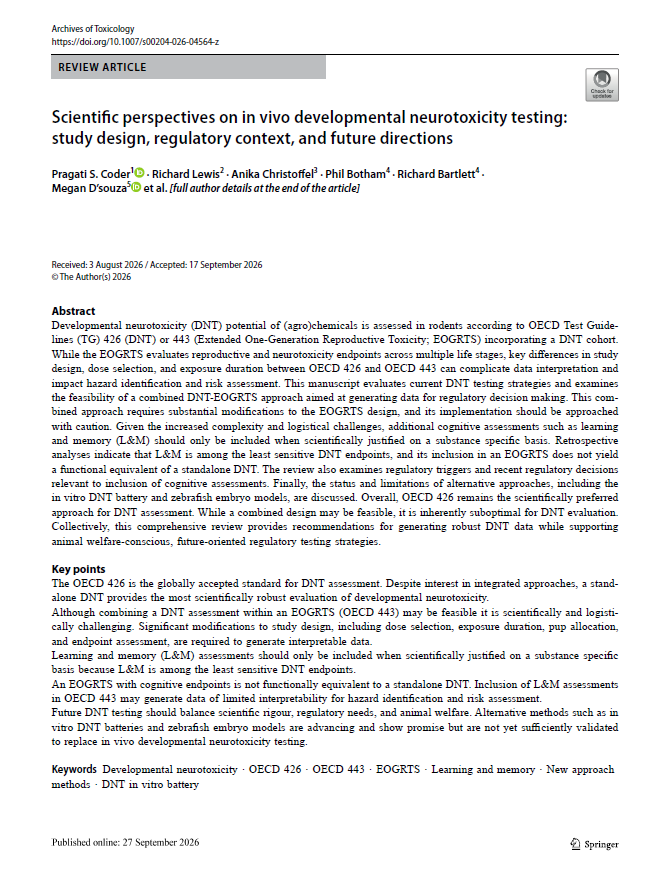
Brussels, 1 October 2026 – ECETOC is pleased to announce the publication of a new review article in Archives of Toxicology titled “Scientific Perspectives on In Vivo Developmental Neurotoxicity T...
Welcome to Talia Neal-Walthall
390510

Welcome to Talia Neal-Walthall

We are pleased to welcome Talia Neal-Walthall to ECETOC as a secondee. Talia joins us to work on topics related to exposure, an area central to much of our current scientific programme. She will be wi...
HSSD Tool

HSSD Tool

This software was developed by a consortium of partners to facilitate the uptake of novel approaches to estimate aquatic threshold concentrations (e.g. the concentration at which 5% of the species are exposed above their EC50, HC5).
The Human Exposure Assessment Tools Database (heatDB)

The Human Exposure Assessment Tools Database (heatDB)

heatdb is a public directory of exposure data sources as well as available tools for exposure
NanoApp

NanoApp

ECETOC’s NanoApp is a tool designed to define the boundaries of sets of similar nanoforms and to generate a justification for the REACH registration.
Targeted Risk Assessment (TRA)

Targeted Risk Assessment (TRA)

The Targeted Risk Assessment (TRA) estimates exposures to workers, consumers and the environment that arise during a series of events.
TRA Task Force – Worker branch

TRA Task Force – Worker branch

Why? The Worker TRA Task Force has been active since 2019, delivering projects that advance the scientific basis of the Worker Targeted Risk Assessment (TRA) tool. Its overarching objective is to e...
Immunotoxicity assessment: Addressing Challenges and Advancing Methodologies [Workshop → Task Force]​

Immunotoxicity assessment: Addressing Challenges and Advancing Methodologies [Workshop → Task Force]​

Why?Regulatory assessment of immunotoxic properties of chemicals is a complex and challenging task​ Limited regulatory guidance exists​ Lack of industry and regulatory knowledge​...
Chronic fish case studies towards an IATA

Chronic fish case studies towards an IATA

Why?Hazard and safety assessments for the pelagic compartment often rely on in vivo studies using a single fish species, raising ethical concerns and uncertainty in terms of extrapolation....
News
01.04.2015

ECETOC Task Force publication presents concept for the grouping and safety assessment of nanomaterials

The safety of nanomaterials can be ensured by undertaking animal testing only as a very last resort. This is the premise and promise of the Decision-making framework for the grouping and testing of nanomaterials - DF4nanoGrouping. The ECETOC Nano Task Force has developed the DF4nanoGrouping based upon an earlier review of existing approaches for the grouping and testing of nanomaterials published in Summer 2014.

Science-based grouping approaches allow the prediction of a substance’s toxicity by comparing it to other similar substances. Thereby, the safety of substances may be determined while considerably saving time, money and animal experimentation. However, the grouping of nanomaterials is more complex than that of ‘conventional’ substances. It requires the joint consideration of physical, chemical and biological properties. Due to this complexity, to date, a unified, comprehensive grouping concept for nanomaterials has not been available. DF4nanoGrouping helps close this severe knowledge gap for hazard and risk assessment.

In three tiers, DF4nanoGrouping takes into consideration all relevant properties of nanomaterials. Step-by-step, potential hazards are ruled out. Safe nanomaterials are identified using non-animal testing, which may then be confirmed applying special animal tests. Further work of the ECETOC Nano Task Force is dedicated to corroborating the applicability of DF4nanoGrouping and promoting its regulatory acceptance.

The ECETOC Nano Task Force Decision-making framework for the grouping and testing of nanomaterials – DF4nanoGrouping is published as an Open Access article in Regulatory Toxicology and Pharmacology.

Arts J, Hadi M, Irfan MA, Keene AM, Kreiling R, Lyon D, Maier M, Michel K, Petry T, Sauer UG, Warheit D, Wiench K, Wohlleben W, Landsiedel R. 2015.

A decision-making framework for the grouping and testing of nanomaterials (DF4nanoGrouping)

Regulatory Toxicology and Pharmacology (In press – uncorrected proof) - Open Access -

http://bit.ly/ecetoc-art2015-arts-et-al