







ECETOC Publication Highlights Scientific Perspectives on Developmental Neurotoxicity Testing and Future Regulatory Directions
390553

ECETOC Publication Highlights Scientific Perspectives on Developmental Neurotoxicity Testing and Future Regulatory Directions

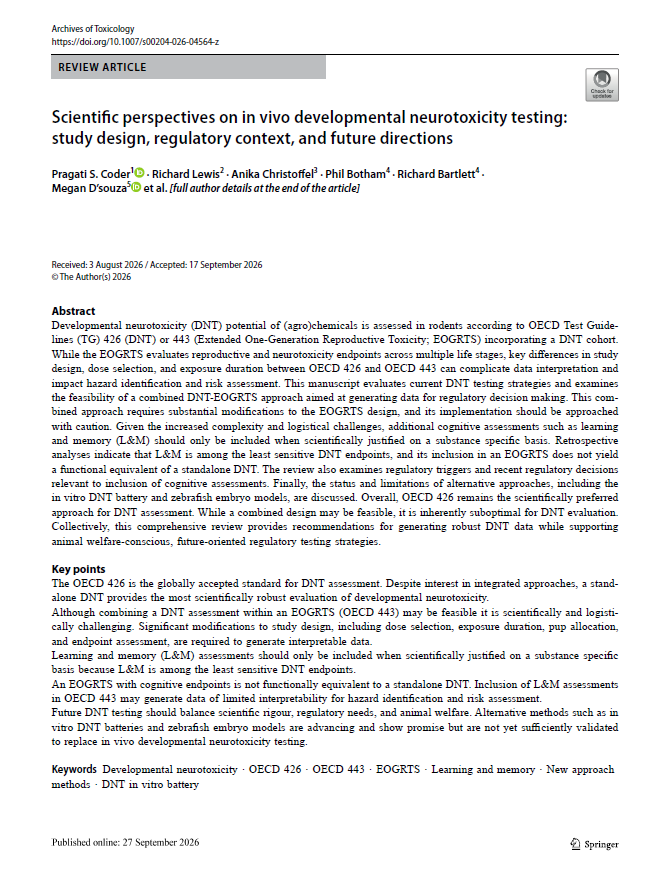
Brussels, 1 October 2026 – ECETOC is pleased to announce the publication of a new review article in Archives of Toxicology titled “Scientific Perspectives on In Vivo Developmental Neurotoxicity T...
Welcome to Talia Neal-Walthall
390510

Welcome to Talia Neal-Walthall

We are pleased to welcome Talia Neal-Walthall to ECETOC as a secondee. Talia joins us to work on topics related to exposure, an area central to much of our current scientific programme. She will be wi...
HSSD Tool

HSSD Tool

This software was developed by a consortium of partners to facilitate the uptake of novel approaches to estimate aquatic threshold concentrations (e.g. the concentration at which 5% of the species are exposed above their EC50, HC5).
The Human Exposure Assessment Tools Database (heatDB)

The Human Exposure Assessment Tools Database (heatDB)

heatdb is a public directory of exposure data sources as well as available tools for exposure
NanoApp

NanoApp

ECETOC’s NanoApp is a tool designed to define the boundaries of sets of similar nanoforms and to generate a justification for the REACH registration.
Targeted Risk Assessment (TRA)

Targeted Risk Assessment (TRA)

The Targeted Risk Assessment (TRA) estimates exposures to workers, consumers and the environment that arise during a series of events.
TRA Task Force – Worker branch

TRA Task Force – Worker branch

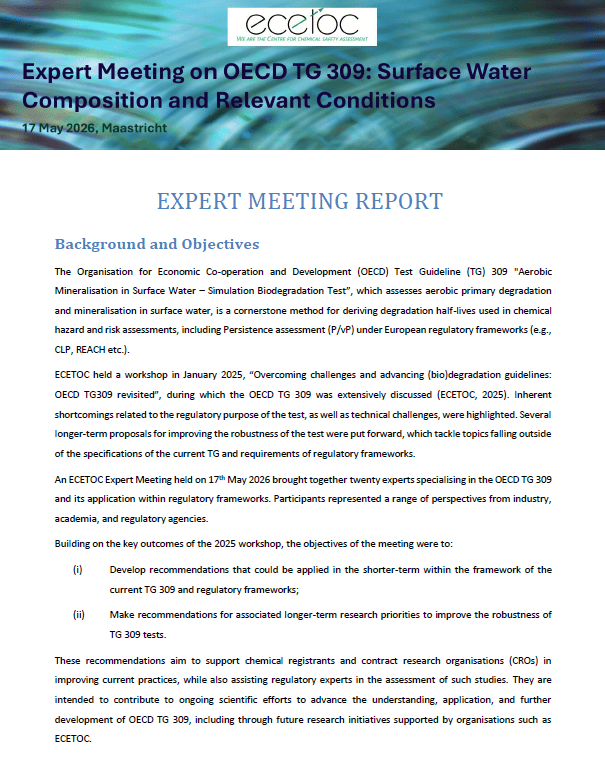
Why? The Worker TRA Task Force has been active since 2019, delivering projects that advance the scientific basis of the Worker Targeted Risk Assessment (TRA) tool. Its overarching objective is to e...
Immunotoxicity assessment: Addressing Challenges and Advancing Methodologies [Workshop → Task Force]​

Immunotoxicity assessment: Addressing Challenges and Advancing Methodologies [Workshop → Task Force]​

Why?Regulatory assessment of immunotoxic properties of chemicals is a complex and challenging task​ Limited regulatory guidance exists​ Lack of industry and regulatory knowledge​...
Chronic fish case studies towards an IATA

Chronic fish case studies towards an IATA

Why?Hazard and safety assessments for the pelagic compartment often rely on in vivo studies using a single fish species, raising ethical concerns and uncertainty in terms of extrapolation....
News
02.11.2009

Workshop looks at the enhancement of the scientific process and transparency of observational epidemiology studies

Environmental epidemiology studies are often treated with scepticism, even by the general public. In the past, scare stories based on findings from such studies, have turned out to be without foundation. There are many reasons for this, among them a pressure to have positive findings that can be published. This is compounded by the non-publication of negative findings and the difficulty to have such studies accepted for publication by high impact journals.

In view of these recurrent issues, ECETOC organised a workshop in London this 24-25 September at the Royal College of Physicians. Among the participants were leading experts from North America and Europe, from academia, government, science journals and industry.

The situation with such “observational studies' was compared with that which previously existed with clinical trials. In this case, it was shown that the trials showing a beneficial effect were more likely to be published than those which did not. One major step was the setting up of “clinical trials registries' which are open to the public and which provide a record of clinical trial designs and outcomes. These are supported by the editorial policies of key journals which only accept manuscripts if they were previously registered in these databases. In addition, the availability of the study protocol allows the results reported to be compared to the outcomes which were planned to be measured.

The workshop reached a consensus that it would be worthwhile to extend this approach to observational epidemiology studies. This approach was not considered to be a panacea, but would lead to improvements in the areas of ethics, transparency and universality (the availability of all data). As the existing databases hosted by the US NIH and the WHO were already suitable for this purpose, it was proposed that they be used, rather than starting a new system.