







Welcome to Talia Neal-Walthall
390510

Welcome to Talia Neal-Walthall

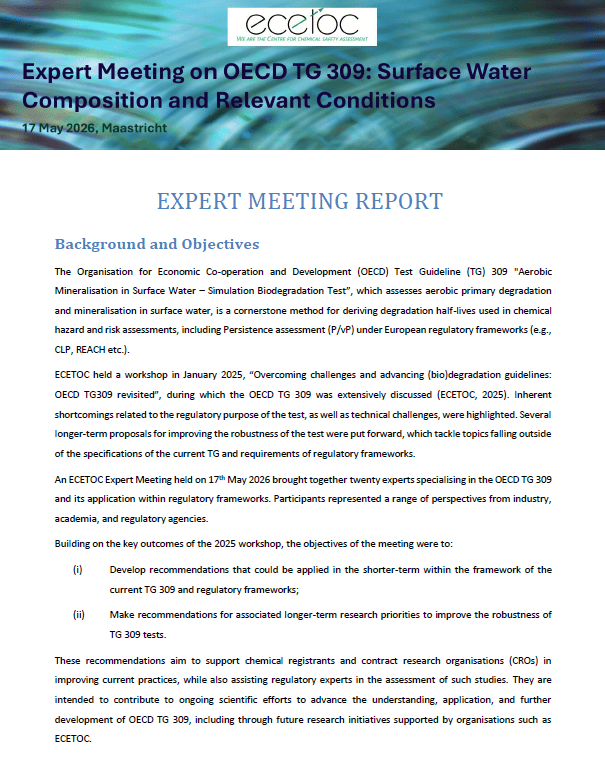
We are pleased to welcome Talia Neal-Walthall to ECETOC as a secondee. Talia joins us to work on topics related to exposure, an area central to much of our current scientific programme. She will be wi...
September 2026 news from the Sec Gen
390509

September 2026 news from the Sec Gen

Dear members and colleagues,As we move through the year, there is a good deal to share. This has been a busy period for ECETOC, with changes to our team, our governance, and the work ahead. Let me...
HSSD Tool

HSSD Tool

This software was developed by a consortium of partners to facilitate the uptake of novel approaches to estimate aquatic threshold concentrations (e.g. the concentration at which 5% of the species are exposed above their EC50, HC5).
The Human Exposure Assessment Tools Database (heatDB)

The Human Exposure Assessment Tools Database (heatDB)

heatdb is a public directory of exposure data sources as well as available tools for exposure
NanoApp

NanoApp

ECETOC’s NanoApp is a tool designed to define the boundaries of sets of similar nanoforms and to generate a justification for the REACH registration.
Targeted Risk Assessment (TRA)

Targeted Risk Assessment (TRA)

The Targeted Risk Assessment (TRA) estimates exposures to workers, consumers and the environment that arise during a series of events.
TRA Task Force – Worker branch

TRA Task Force – Worker branch

Why? The Worker TRA Task Force has been active since 2019, delivering projects that advance the scientific basis of the Worker Targeted Risk Assessment (TRA) tool. Its overarching objective is to e...
Immunotoxicity assessment: Addressing Challenges and Advancing Methodologies [Workshop → Task Force]​

Immunotoxicity assessment: Addressing Challenges and Advancing Methodologies [Workshop → Task Force]​

Why?Regulatory assessment of immunotoxic properties of chemicals is a complex and challenging task​ Limited regulatory guidance exists​ Lack of industry and regulatory knowledge​...
Chronic fish case studies towards an IATA

Chronic fish case studies towards an IATA

Why?Hazard and safety assessments for the pelagic compartment often rely on in vivo studies using a single fish species, raising ethical concerns and uncertainty in terms of extrapolation....
Press Release
26.04.2011

Article published on using mode of action information to improve regulatory decision-making

The European Centre for Ecotoxicology and Toxicology of Chemicals (ECETOC), the International Life Sciences Institute (ILSI) Research Foundation (RF), and the ILSI Health and Environmental Sciences Institute (HESI) hosted a workshop in November 2009 to review current practice in the application of mode of action (MOA) considerations in chemical risk assessment. The aim was to provide a rationale for a more general, but flexible approach and to propose steps to facilitate broader uptake and use of the MOA concept. There was consensus amongst the workshop participants that it will require substantial effort and cooperation from the multiple disciplines involved to embrace a common, consistent, and transparent approach. Setting up a repository of accepted MOAs and associated guidance concerning appropriate data to support specific MOAs for critical effects would facilitate categorization of chemicals and allow predictions of toxicity outcomes by read-across. This should in future contribute to the reduction of toxicity testing in animals. The workshop participants also acknowledged the value and importance of human data and the importance of integrating information from biological pathway analyses into current MOA/human relevance frameworks.

Carmichael N, Bausen M, Boobis AR, Cohen SM, Embry M, Fruijtier-Pölloth C, Greim H, Lewis R, Bette Meek ME, Mellor H, Vickers C, Doe J. 2011.

Using mode of action information to improve regulatory decision-making: An ECETOC/ILSI RF/HESI workshop overview.

Critical Reviews in Toxicology 41(3):175-86. 41(3):175-86.

doi:10.3109/10408444.2010.541225

(ECETOC has arranged free online access to this article for 6 months.)