






2025 Annual Report
Annual Report
ECETOC publishes a framework for the risk assessment of plastic additives
Press Release

ECETOC publishes a framework for the risk assessment of plastic additives

Part 1 sets out the fundamental elements, from problem formulation to risk characterisation.Brussels, 22 July 2026. The ECETOC Plastic Additives Task Force has published the first of two peer...
January 2026 news from the Sec Gen
News

January 2026 news from the Sec Gen

Dear colleagues and friends,As we begin a new year, I would like to thank you for your continued engagement and trust in ECETOC. 2026 promises to be an exciting and dynamic year, and I am pleased...
HSSD Tool

HSSD Tool

This software was developed by a consortium of partners to facilitate the uptake of novel approaches to estimate aquatic threshold concentrations (e.g. the concentration at which 5% of the species are exposed above their EC50, HC5).
The Human Exposure Assessment Tools Database (heatDB)

The Human Exposure Assessment Tools Database (heatDB)

heatdb is a public directory of exposure data sources as well as available tools for exposure
NanoApp

NanoApp

ECETOC’s NanoApp is a tool designed to define the boundaries of sets of similar nanoforms and to generate a justification for the REACH registration.
Targeted Risk Assessment (TRA)

Targeted Risk Assessment (TRA)

The Targeted Risk Assessment (TRA) estimates exposures to workers, consumers and the environment that arise during a series of events.
TRA Task Force – Worker branch

TRA Task Force – Worker branch

Why? The Worker TRA Task Force has been active since 2019, delivering projects that advance the scientific basis of the Worker Targeted Risk Assessment (TRA) tool. Its overarching objective is to e...
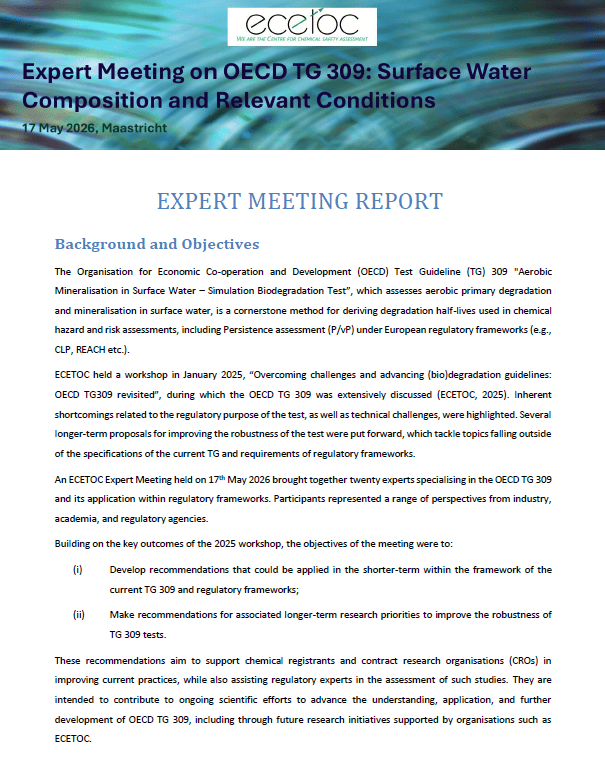
Immunotoxicity assessment: Addressing Challenges and Advancing Methodologies [Workshop → Task Force]​

Immunotoxicity assessment: Addressing Challenges and Advancing Methodologies [Workshop → Task Force]​

Why?Regulatory assessment of immunotoxic properties of chemicals is a complex and challenging task​ Limited regulatory guidance exists​ Lack of industry and regulatory knowledge​...
Chronic fish case studies towards an IATA

Chronic fish case studies towards an IATA

Why?Hazard and safety assessments for the pelagic compartment often rely on in vivo studies using a single fish species, raising ethical concerns and uncertainty in terms of extrapolation....
Event
29.10.2015 - 30.10.2015

Defining the role of chemical activity in environmental risk assessment within the context of mode of action: Practical guidance and advice

Snowbird Resort, Utah, USA

This ECETOC workshop will be held prior to the SETAC North America meeting in Salt Lake City, Utah as many of the scientists will attend that meeting too. Society is facing a variety of challenges in environmental risk assessment (ERA): growing concerns about the effects of multiple stressors (chemical and non-chemical); risks associated with exposure to complex mixtures; and demands to quantify local site-specific risks. At the same time, risk assessors are seeking to provide a more efficient framework on which to address these emerging problems and questions in a manner that reduces cost and the use of animals.

The workgroup will assess the applicability of using chemical activity in the interpretation of effects data. Recent studies have demonstrated the utility of the concept with respect to acute baseline toxicity, consequently the emphasis of this workgroup will be on expanding the concept to chronic baseline toxicity and providing guidance regarding the handling of acute effects for non-narcotic chemicals.

This Workshop was a recommendation of ECETOC Technical Report no. 120 and follows the work of Cefic LRI ECO16.