







2025 Annual Report
Annual Report
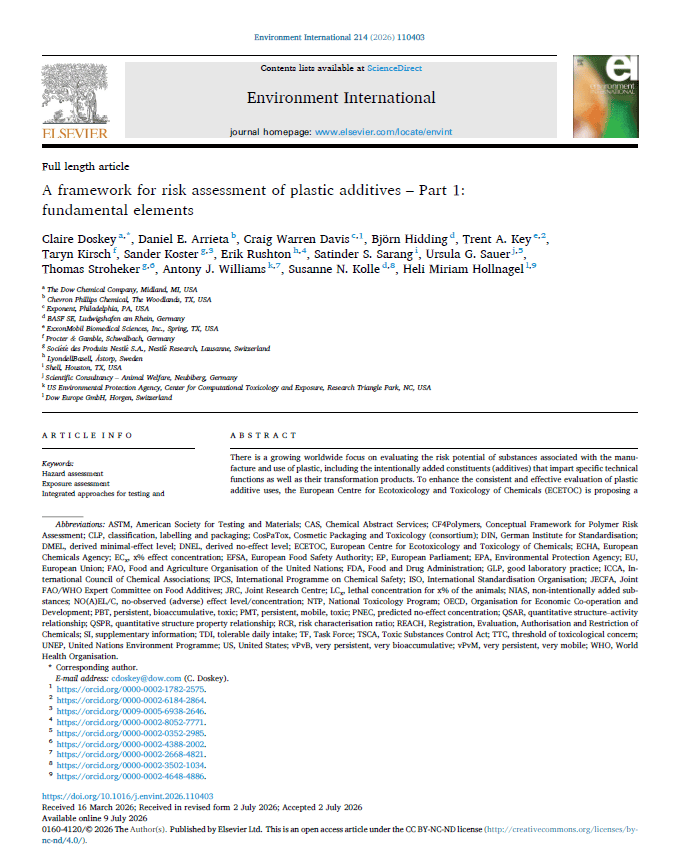
ECETOC publishes a framework for the risk assessment of plastic additives
Press Release

ECETOC publishes a framework for the risk assessment of plastic additives

Part 1 sets out the fundamental elements, from problem formulation to risk characterisation.Brussels, 22 July 2026. The ECETOC Plastic Additives Task Force has published the first of two peer...
January 2026 news from the Sec Gen
News

January 2026 news from the Sec Gen

Dear colleagues and friends,As we begin a new year, I would like to thank you for your continued engagement and trust in ECETOC. 2026 promises to be an exciting and dynamic year, and I am pleased...
HSSD Tool

HSSD Tool

This software was developed by a consortium of partners to facilitate the uptake of novel approaches to estimate aquatic threshold concentrations (e.g. the concentration at which 5% of the species are exposed above their EC50, HC5).
The Human Exposure Assessment Tools Database (heatDB)

The Human Exposure Assessment Tools Database (heatDB)

heatdb is a public directory of exposure data sources as well as available tools for exposure
NanoApp

NanoApp

ECETOC’s NanoApp is a tool designed to define the boundaries of sets of similar nanoforms and to generate a justification for the REACH registration.
Targeted Risk Assessment (TRA)

Targeted Risk Assessment (TRA)

The Targeted Risk Assessment (TRA) estimates exposures to workers, consumers and the environment that arise during a series of events.
TRA Task Force – Worker branch

TRA Task Force – Worker branch

Why? The Worker TRA Task Force has been active since 2019, delivering projects that advance the scientific basis of the Worker Targeted Risk Assessment (TRA) tool. Its overarching objective is to e...
Immunotoxicity assessment: Addressing Challenges and Advancing Methodologies [Workshop → Task Force]​

Immunotoxicity assessment: Addressing Challenges and Advancing Methodologies [Workshop → Task Force]​

Why?Regulatory assessment of immunotoxic properties of chemicals is a complex and challenging task​ Limited regulatory guidance exists​ Lack of industry and regulatory knowledge​...
Chronic fish case studies towards an IATA

Chronic fish case studies towards an IATA

Why?Hazard and safety assessments for the pelagic compartment often rely on in vivo studies using a single fish species, raising ethical concerns and uncertainty in terms of extrapolation....
Technical Report
29.12.2002

TR 084 – Scientific Principles for Soil Hazard Assessment of Substances

TR 084 : Scientific Principles for Soil Hazard Assessment of Substances | July 2002

This report reviews the scientific principles that should underpin any future terrestrial (soil) hazard classification scheme for organic and inorganic substances. The terrestrial effects of a substance are determined by a combination of its intrinsic toxicity and bioavailability, and these two factors are considered to be the main drivers for soil hazard classification. Experimental effects data are always a combination of both factors, and need to be standardised and normalised before they are useful for classification purposes. Surrogate data, including read-across from aquatic effects data and equilibrium partitioning for organic substances, and 'transformation  data for substances of low solubility, may lead to both over- and under-estimates of terrestrial hazard, and should be applied with caution.

Modifying factors to be included in a soil classification scheme are related to elimination (the length of time a substance is likely to stay in the soil compartment) or possible long-term effects (long-term toxicity). Factors not recommended for inclusion in such a scheme are bioaccumulation and slope of the dose-response curve.

Certain main elements of a terrestrial classification scheme, including selection of the most appropriate terrestrial test guidelines, assessment of data quality and relevance, read-across methods from aquatic data and how to incorporate the modifying factors, merit further development.

The Task Force considered that the current EC risk phrases related to individual terrestrial organisms living in soil were not appropriate and would be better replaced by a classification based on two or three toxicity classes amended by a term for potential long-term effects. This is analogous to the existing classification scheme for the aquatic environment and would therefore encourage harmonisation, and improve transparency and ease of use.