






![Immunotoxicity assessment: Addressing Challenges and Advancing Methodologies [Workshop → Task Force]](https://www.ecetoc.org/wp-content/uploads/2026/07/Picture2-1024x923.jpg)



ECETOC Workshop Report Highlights Advances and Challenges in Biodegradation Testing Guidelines
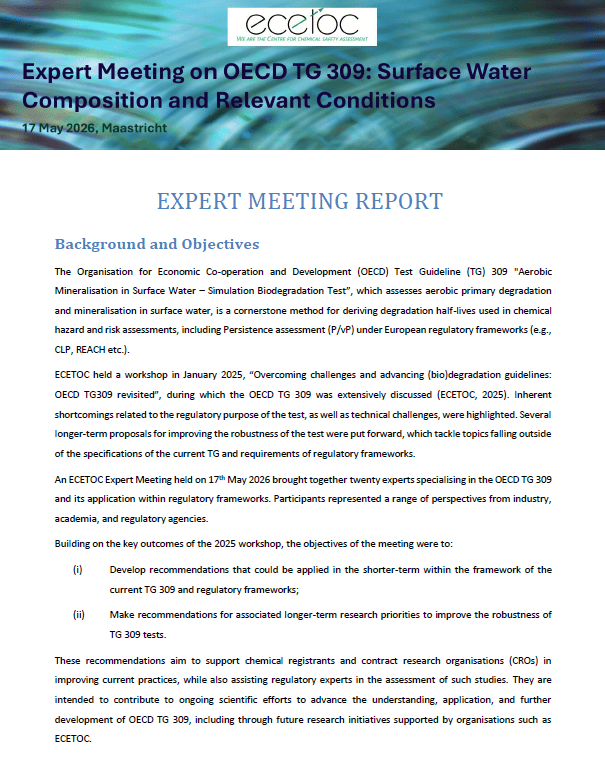
Brussels, June 2025 – The European Centre for Ecotoxicology and Toxicology of Chemicals (ECETOC) has released its latest workshop report, “Overcoming challenges and advancing (bio)degradation guidelines: OECD TG309 revisited,” summarizing key discussions and recommendations from a recent expert gathering held in Brussels in January 2025.
The OECD Test Guideline (TG) 309, designed to assess the degradation of chemicals in aerobic surface water, has become increasingly important in regulatory frameworks, especially within the EU. As its use grows, so do concerns about its robustness, practical implementation, and environmental relevance. In response, ECETOC convened a 1.5-day workshop bringing together in-person and online participants from industry, academia, regulatory bodies, and contract research organizations to address these challenges.
The workshop was structured around three main objectives:
- Discuss current challenges and limitations in conducting and interpreting biodegradation simulation studies.
- Define and align on key updates needed for OECD TG 309.
- Establish a roadmap for prioritized updates and identify research needs to enhance the guideline’s relevance and applicability.
The workshop focused on three pillars: robustness, implementation, and relevance.
- Robustness: Experts highlighted the need for improved standardization and reproducibility, particularly regarding microbial biomass concentration and characterization. Permitted variations in experimental setups were identified as a major source of variability in results. Solutions proposed included better guidance on inoculum sampling and storage, more stringent reporting requirements, and consideration of suspended sediment to improve test robustness.
- Implementation: Practical challenges in routine testing were discussed, especially for substances with difficult-to-test properties or complex compositions. Recommendations included refining the applicability domain of the guideline, improving data reporting templates, and clarifying definitions for aerobic conditions and controls.
- Relevance: The current guideline was found to poorly reflect real-world environmental degradation. Key suggestions included splitting the guideline according to different test objectives, using lower test substance concentrations to better mimic environmental conditions, and providing clearer guidance on inoculum selection and light conditions.
This workshop provided a timely forum for experts to address the growing importance of OECD TG 309 and to outline actionable steps for its improvement. The report’s findings will inform ongoing revisions to the guideline and help ensure that future biodegradation assessments are robust, practical, and environmentally relevant.