







2025 Annual Report
Annual Report
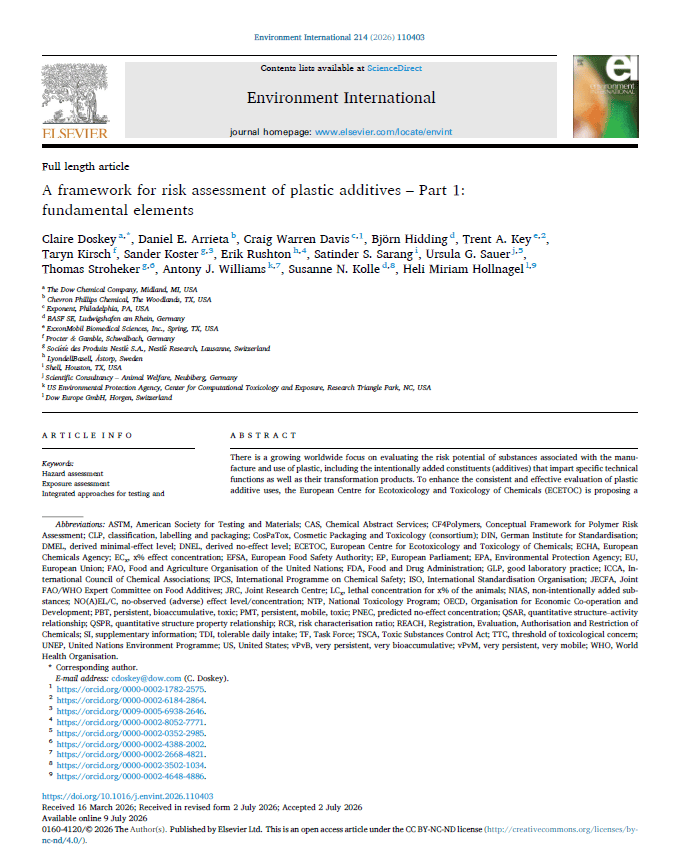
ECETOC publishes a framework for the risk assessment of plastic additives
Press Release

ECETOC publishes a framework for the risk assessment of plastic additives

Part 1 sets out the fundamental elements, from problem formulation to risk characterisation.Brussels, 22 July 2026. The ECETOC Plastic Additives Task Force has published the first of two peer...
January 2026 news from the Sec Gen
News

January 2026 news from the Sec Gen

Dear colleagues and friends,As we begin a new year, I would like to thank you for your continued engagement and trust in ECETOC. 2026 promises to be an exciting and dynamic year, and I am pleased...
HSSD Tool

HSSD Tool

This software was developed by a consortium of partners to facilitate the uptake of novel approaches to estimate aquatic threshold concentrations (e.g. the concentration at which 5% of the species are exposed above their EC50, HC5).
The Human Exposure Assessment Tools Database (heatDB)

The Human Exposure Assessment Tools Database (heatDB)

heatdb is a public directory of exposure data sources as well as available tools for exposure
NanoApp

NanoApp

ECETOC’s NanoApp is a tool designed to define the boundaries of sets of similar nanoforms and to generate a justification for the REACH registration.
Targeted Risk Assessment (TRA)

Targeted Risk Assessment (TRA)

The Targeted Risk Assessment (TRA) estimates exposures to workers, consumers and the environment that arise during a series of events.
Chronic fish case studies towards an IATA

Chronic fish case studies towards an IATA

Why?Hazard and safety assessments for the pelagic compartment often rely on in vivo studies using a single fish species, raising ethical concerns and uncertainty in terms of extrapolation....
Estimating the environmental release of Synthetic Polymeric Microparticles from Products

Estimating the environmental release of Synthetic Polymeric Microparticles from Products

Why?REACH restriction: SPM use restricted; emissions reporting required by May 2027. Gap: No analytical methods available to measure SPM emissions. Solution: Draft SPERC-based approac...
Case Studies on Reliability and Relevance Considerations during Validation of NAMs

Case Studies on Reliability and Relevance Considerations during Validation of NAMs

Why?Validation of NAMs is often overlooked despite its importance for regulatory use. Traditional validation methods are less suitable for NAMs, which focus on key events rather than apical...
Task Force
06.03.2024

Scientific perspective on in vivo DNT testing

Why

Discussions are ongoing regarding the integration of developmental neuroxocixity (DNT) testing in chemical safety assessment in Europe (e.g. via inclusion of DNT cohorts in EOGRT studies (OECD TG 443) or DNT (OECD TG 426) testing).

In addition, in vitro DNT tests are under development the outcome of which may trigger follow-up in vivo testing.

Therefore, there is a need to provide scientifically justifiable options and recommendations for integration of DNT testing in chemical risk assessments.

Objectives

  • Review options to amend/enhance existing paradigm (OECD 443 (additional DNT cohorts)/OECD 426)
  • Evaluate key DNT endpoints, incl. challenges in interpretation
  • Explore future integrated testing strategy, e.g. incorporating in vitro and current/future regulatory trend

Timeline and deliverables

Work started in February 2024 and the Task Force plans to have a manuscript ready for submission by the end of 2026.