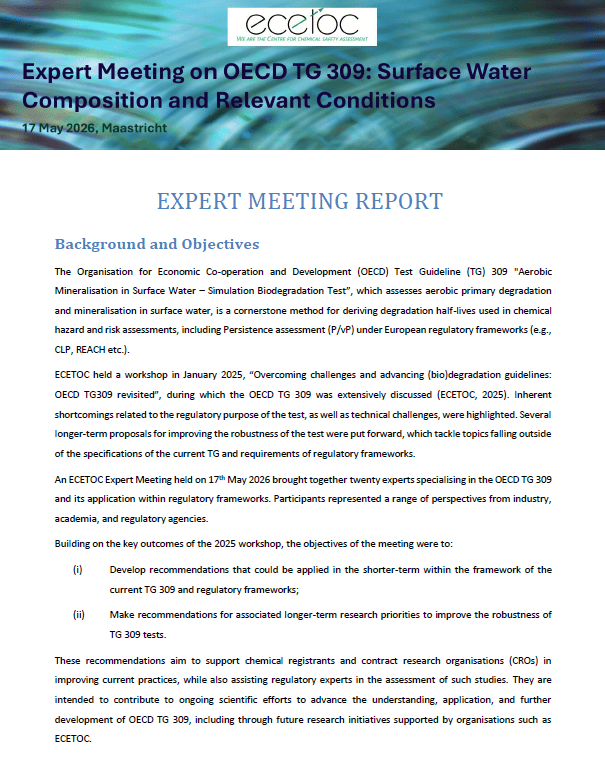









New ECETOC expert report: Advancing OECD TG 309 biodegradation testing
390508

New ECETOC expert report: Advancing OECD TG 309 biodegradation testing

A new expert meeting report is now available on the ECETOC website exploring how OECD TG 309 can be made more robust and environmentally relevant for chemical persistence assessment. The report ref...
We’re Hiring: Join the ECETOC Team as a Trainee!
390494

We’re Hiring: Join the ECETOC Team as a Trainee!

Are you passionate about science, regulatory toxicology, and making a real-world impact at the intersection of industry, academia, and policy? ECETOC is excited to announce that we’re looking for a...
HSSD Tool

HSSD Tool

This software was developed by a consortium of partners to facilitate the uptake of novel approaches to estimate aquatic threshold concentrations (e.g. the concentration at which 5% of the species are exposed above their EC50, HC5).
The Human Exposure Assessment Tools Database (heatDB)

The Human Exposure Assessment Tools Database (heatDB)

heatdb is a public directory of exposure data sources as well as available tools for exposure
NanoApp

NanoApp

ECETOC’s NanoApp is a tool designed to define the boundaries of sets of similar nanoforms and to generate a justification for the REACH registration.
Targeted Risk Assessment (TRA)

Targeted Risk Assessment (TRA)

The Targeted Risk Assessment (TRA) estimates exposures to workers, consumers and the environment that arise during a series of events.
TRA Task Force – Worker branch

TRA Task Force – Worker branch

Why? The Worker TRA Task Force has been active since 2019, delivering projects that advance the scientific basis of the Worker Targeted Risk Assessment (TRA) tool. Its overarching objective is to e...
Immunotoxicity assessment: Addressing Challenges and Advancing Methodologies [Workshop → Task Force]​

Immunotoxicity assessment: Addressing Challenges and Advancing Methodologies [Workshop → Task Force]​

Why?Regulatory assessment of immunotoxic properties of chemicals is a complex and challenging task​ Limited regulatory guidance exists​ Lack of industry and regulatory knowledge​...
Chronic fish case studies towards an IATA

Chronic fish case studies towards an IATA

Why?Hazard and safety assessments for the pelagic compartment often rely on in vivo studies using a single fish species, raising ethical concerns and uncertainty in terms of extrapolation....
Task Force
12.06.2014

Assessment and evaluation of risks resulting from dermal exposure to chemicals

Completed task force: The task force published its findings in March 2013 as Technical Report no.119: Evaluation of systemic health effects following dermal exposure to chemicals

Health Sciences Manager Christa Hennes

Administrative Assistant Christine Yannakas

Background

Expert groups, like DG SANCO's scientific committees, have recently voiced concerns that there is little knowledge available on skin exposure and penetration of industrial chemicals, in contrast to exposure via the inhalation route. To address this, a task force was formed to build on the extensive expertise in the area of dermal exposure especially within the agrochemical industry.

The remit of the task force is to develop a tiered, practical strategy for the assessment and evaluation of dermal risks from chemicals, thereby taking into account recent scientific advances. This activity could also be a valuable input to chemical assessments for REACH in relation to exposure scenarios, and it could guide industry internal decision making when designing toxicological studies.