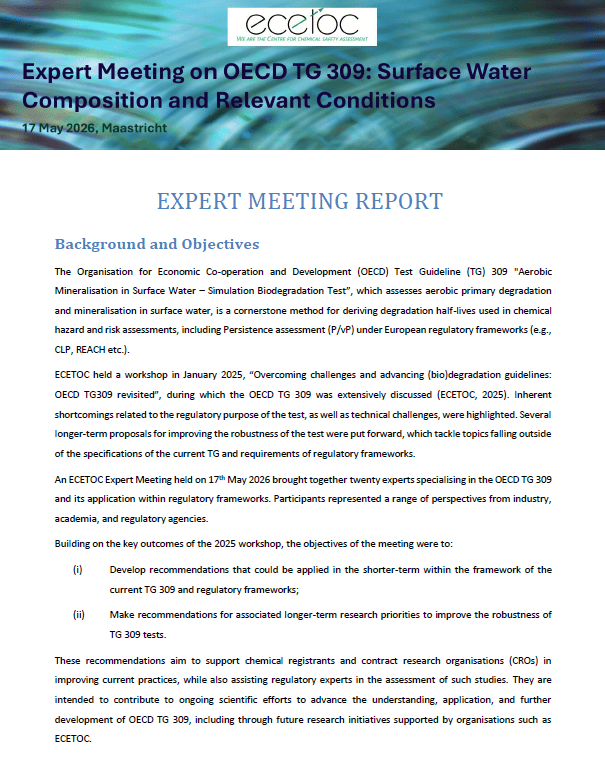
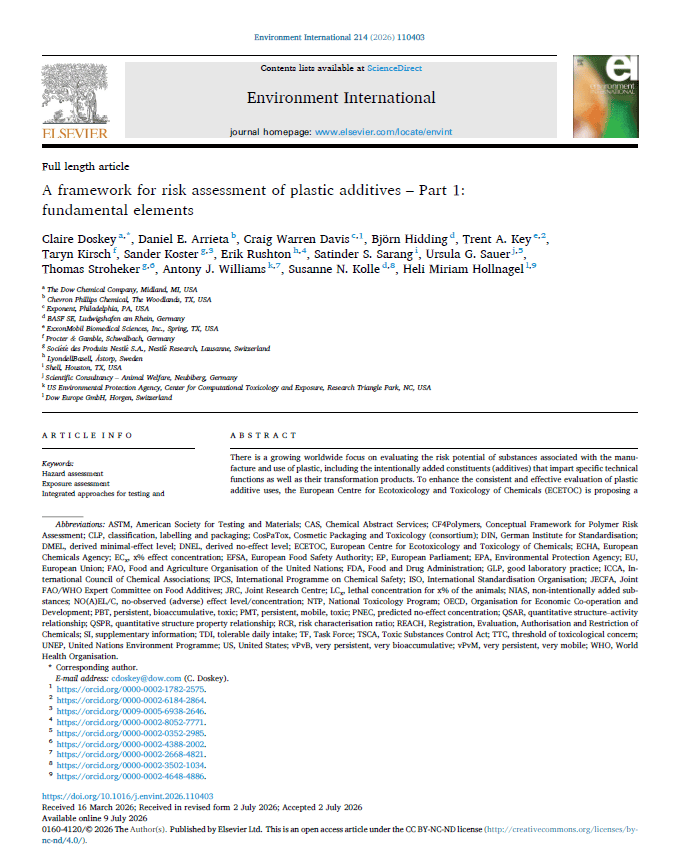










![Immunotoxicity assessment: Addressing Challenges and Advancing Methodologies [Workshop → Task Force]](https://www.ecetoc.org/wp-content/uploads/2026/07/Picture2-1024x923.jpg)



TR 090 – Persistence of Chemicals in the Environment
TR 090 : Persistence of Chemicals in the Environment | October 2003
This review considers the current definition of persistence of chemicals in the environment, the factors that influence their degradation, methods currently used to measure degradation and the extent to which current standard degradation tests can be used to infer 'persistence'. The review highlights the fact that a single, scientifically-agreed definition of 'persistence' does not exist and that regulatory bodies evaluate the persistence of chemical substances in an inconsistent manner.
A strategy that comprises a screening stage and a confirmatory stage which are applicable to both new and existing chemical substances is proposed for inferring persistence of a chemical in the environment. All available partitioning and degradation data, whether from standard or non-standard tests, should be used when assessing the persistence of a chemical substance. The testing strategy also covers the situation where no data exists or where existing data are insufficient or inadequate. It incorporates improved tests that take into account factors such as microbial adaptation, microbial diversity and low substance concentration. Every realistic opportunity for biodegradation to occur should be allowed, this includes the use of semi-continuous and continuous test systems, and inocula pre-exposed to the test substance. The potential for adaptation is identical for both new and existing substances. However, the use pattern (continuous or intermittent) and environmental loading of a substance will control the time taken for adaptation to occur in the environment.
The report recommends that pre-exposure regimes, for substances continuously released, and the use of inoculum densities that do not compromise the potential for biodegradation should be used to determine the true persistence of a chemical substance. A major change to the current test-based approach used to assess persistence is proposed. In the confirmatory stage, the effective use of multi-media modelling, is advocated, to target testing in specific environmental compartments, where significant realistic presence is predicted. Multi-media modelling may also be used at the confirmatory stage, to assess the overall persistence of a chemical (i.e. in the environmental as a whole) on the basis of its emission scenario, partitioning characteristics and media-specific removal or degradation rates. This can help to confirm classifications that are based on measured data and assist in prioritisation of testing programmes based on an objective and holistic approach.
In brief, this strategy maximises the use of existing degradation data, from standard and non-standard tests, and promotes the generation of new data from appropriate novel and emerging tests. The areas where further research is required are also discussed. In particular, the need to understand the quantitative impact of the different factors governing biodegradation rates in the environment i.e. physical properties of the molecule and the system constraints (laboratory and environmental), the development of tests at low concentrations and the relative rates of degradation in fresh water and salt water environments should be addressed.