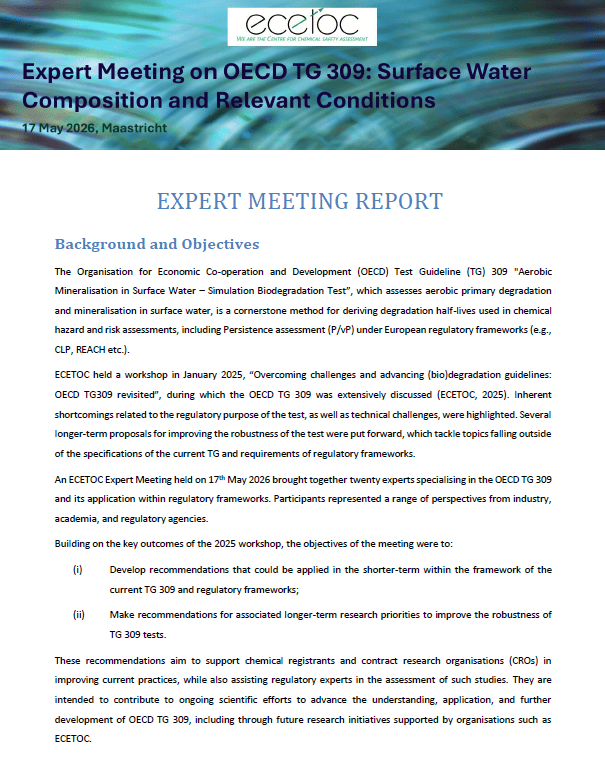









New ECETOC expert report: Advancing OECD TG 309 biodegradation testing
390508

New ECETOC expert report: Advancing OECD TG 309 biodegradation testing

A new expert meeting report is now available on the ECETOC website exploring how OECD TG 309 can be made more robust and environmentally relevant for chemical persistence assessment. The report ref...
We’re Hiring: Join the ECETOC Team as a Trainee!
390494

We’re Hiring: Join the ECETOC Team as a Trainee!

Are you passionate about science, regulatory toxicology, and making a real-world impact at the intersection of industry, academia, and policy? ECETOC is excited to announce that we’re looking for a...
HSSD Tool

HSSD Tool

This software was developed by a consortium of partners to facilitate the uptake of novel approaches to estimate aquatic threshold concentrations (e.g. the concentration at which 5% of the species are exposed above their EC50, HC5).
The Human Exposure Assessment Tools Database (heatDB)

The Human Exposure Assessment Tools Database (heatDB)

heatdb is a public directory of exposure data sources as well as available tools for exposure
NanoApp

NanoApp

ECETOC’s NanoApp is a tool designed to define the boundaries of sets of similar nanoforms and to generate a justification for the REACH registration.
Targeted Risk Assessment (TRA)

Targeted Risk Assessment (TRA)

The Targeted Risk Assessment (TRA) estimates exposures to workers, consumers and the environment that arise during a series of events.
TRA Task Force – Worker branch

TRA Task Force – Worker branch

Why? The Worker TRA Task Force has been active since 2019, delivering projects that advance the scientific basis of the Worker Targeted Risk Assessment (TRA) tool. Its overarching objective is to e...
Immunotoxicity assessment: Addressing Challenges and Advancing Methodologies [Workshop → Task Force]​

Immunotoxicity assessment: Addressing Challenges and Advancing Methodologies [Workshop → Task Force]​

Why?Regulatory assessment of immunotoxic properties of chemicals is a complex and challenging task​ Limited regulatory guidance exists​ Lack of industry and regulatory knowledge​...
Chronic fish case studies towards an IATA

Chronic fish case studies towards an IATA

Why?Hazard and safety assessments for the pelagic compartment often rely on in vivo studies using a single fish species, raising ethical concerns and uncertainty in terms of extrapolation....
Workshop Report
28.11.2009

Workshop Report 18 – Enhancement of the Scientific Process and Transparency of Observational Epidemiology Studies

WR 18 : Enhancement of the Scientific Process and Transparency of Observational Epidemiology Studies | November 2009

Background:

Observational epidemiology studies have greatly contributed to the identification of causes of disease. The research methods applied in observational epidemiology studies have extensively described in textbooks and publications. However, the conduct of observational epidemiology studies in essence is not subject to agreed guidelines and there is no guarantee that study results are comprehensively disclosed in the form of scientific publications. Because of various reasons some study results, either positive or negative, may remain undisclosed which may introduce a distorted representation of study findings in the open scientific literature. Industry researchers may be accused of only publishing those results that are more favorable to industry. On the other hand, non industry researchers may be accused of only disclosing those results that are the most interesting to report and carry the most weight, these being the positive findings.

A more systematic and transparent process for the conduct of observational epidemiology studies, in line with the existing process for clinical trials, will improve the reliability and credibility of observational epidemiology.

The envisaged scientific process would include a register where study protocols are deposited prior to the actual conduct of the study, a more rigorous process for documenting and archiving collected data, and could lead to a "Cochrane Collaboration like" institution to coordinate the conduct of systematic reviews on observational epidemiology studies, and ideally a raw data repository.