









We’re Hiring: Join the ECETOC Team as a Trainee!
390494

We’re Hiring: Join the ECETOC Team as a Trainee!

Are you passionate about science, regulatory toxicology, and making a real-world impact at the intersection of industry, academia, and policy? ECETOC is excited to announce that we’re looking for a...
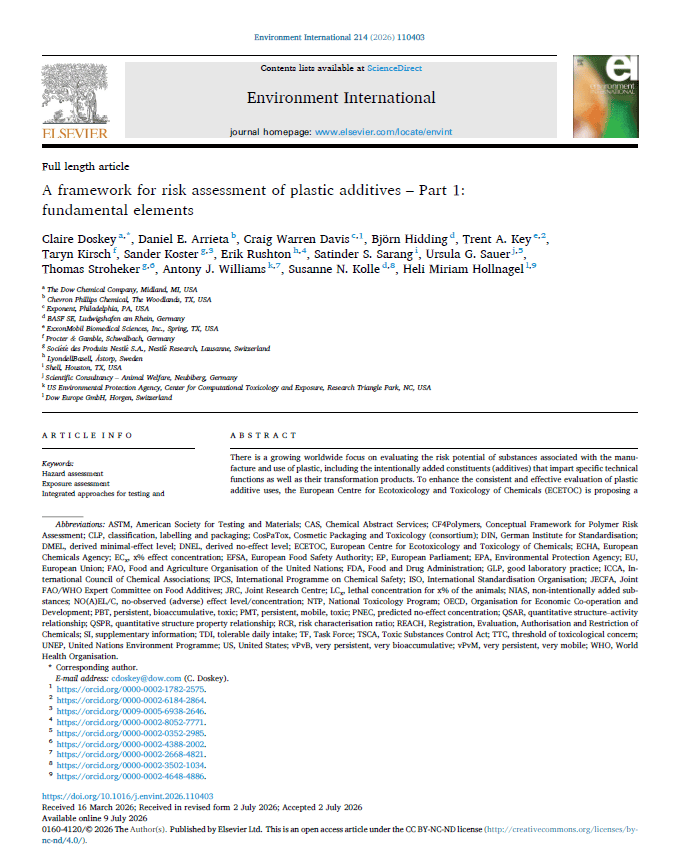
ECETOC publishes a framework for the risk assessment of plastic additives
390456

ECETOC publishes a framework for the risk assessment of plastic additives

Part 1 sets out the fundamental elements, from problem formulation to risk characterisation.Brussels, 22 July 2026. The ECETOC Plastic Additives Task Force has published the first of two peer...
HSSD Tool

HSSD Tool

This software was developed by a consortium of partners to facilitate the uptake of novel approaches to estimate aquatic threshold concentrations (e.g. the concentration at which 5% of the species are exposed above their EC50, HC5).
The Human Exposure Assessment Tools Database (heatDB)

The Human Exposure Assessment Tools Database (heatDB)

heatdb is a public directory of exposure data sources as well as available tools for exposure
NanoApp

NanoApp

ECETOC’s NanoApp is a tool designed to define the boundaries of sets of similar nanoforms and to generate a justification for the REACH registration.
Targeted Risk Assessment (TRA)

Targeted Risk Assessment (TRA)

The Targeted Risk Assessment (TRA) estimates exposures to workers, consumers and the environment that arise during a series of events.
TRA Task Force – Worker branch

TRA Task Force – Worker branch

Why? The Worker TRA Task Force has been active since 2019, delivering projects that advance the scientific basis of the Worker Targeted Risk Assessment (TRA) tool. Its overarching objective is to e...
Immunotoxicity assessment: Addressing Challenges and Advancing Methodologies [Workshop → Task Force]​

Immunotoxicity assessment: Addressing Challenges and Advancing Methodologies [Workshop → Task Force]​

Why?Regulatory assessment of immunotoxic properties of chemicals is a complex and challenging task​ Limited regulatory guidance exists​ Lack of industry and regulatory knowledge​...
Chronic fish case studies towards an IATA

Chronic fish case studies towards an IATA

Why?Hazard and safety assessments for the pelagic compartment often rely on in vivo studies using a single fish species, raising ethical concerns and uncertainty in terms of extrapolation....
Event
02.11.2009 - 03.11.2009

Using Mode of Action Information to Improve Regulatory Decision Making

Introduction

A workshop entitled “Using mode of action information to improve regulatory decision making' was held 2-3 November at the City Presentation Centre in London. This event was organised in co-operation with HESI, and was sponsored by Cefic LRI.

The main goal of the meeting was to examine to what extent toxicological mode of action information can be used to modify human risk assessment. This approach evaluates the known key steps in the toxicological mode of action in animals with the available information on the relevance of this pathway in man.

The discussion centred on the “mode of action framework' which is promoted by the WHO International Programme on Chemical Safety (IPCS) and is similar to the approach proposed by ECETOC in Technical Report 99 - “Toxicological modes of action: relevance for human risk assessment' which was published in 2006.

Presentations were made by a distinguished group of speakers from academia and industry, which used case studies to illustrate the practical use of the framework.

Conclusions and recommendations

There was a high level of agreement on using this approach where sufficient information is available to characterise a “mode of action'. There was of course some debate as to how much data would be needed to establish a “known mode of action', which could then be extrapolated from one example to less thoroughly investigated chemicals. One of the main recommendations of this meeting was the establishment of a register of those modes of action which are sufficiently well described as to be useful in employing this approach in risk assessment within a regulatory context.