With the objective of recognising young scientists, ECETOC has been active in the provision of an annual Science Award to outstanding works of science since 2003. The 1st Science Award was launched to recognise the achievements of three promising European investigators in the fields of science relevant to ECETOC's mission of supporting the safe manufacturing and use of chemicals, pharmaceuticals and biomaterials through sound science. Since then the format of the Award may have varied, however the objectives have remained the same.
![]()
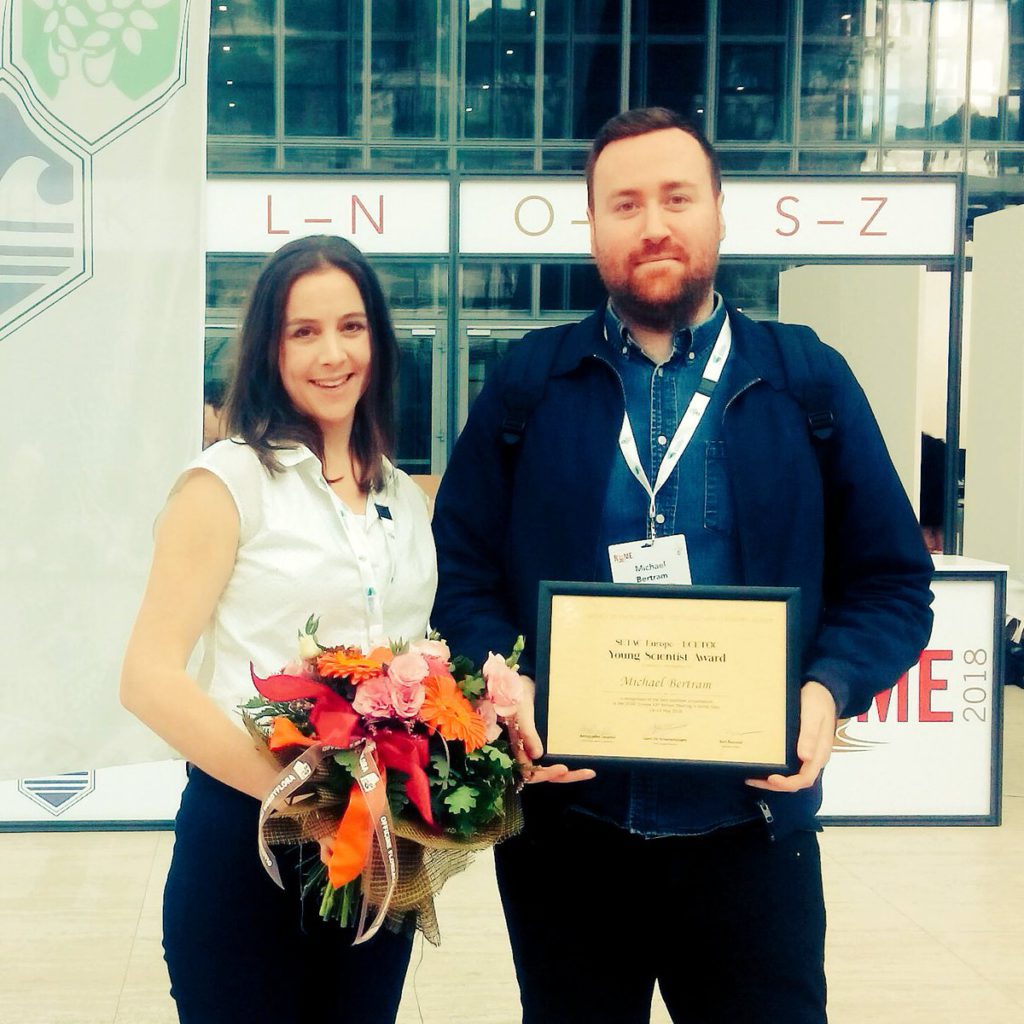
ECETOC Young Scientist Awards - Best Platform Award presentation at SETAC
Ms. A.M. Boulay from the École Polytéchnique, Montréal, Canada, has won this year's ECETOC Young Scientist Award on environmental research. She was chosen for the award for her excellent research on ‘Using GIS to evaluate regional human health impacts from water use' and the platform presentation at the annual conference of SETAC Europe on 23rd-27th May 2010 in Seville

John Doe presents the 'Next generation of scientists award' to Jillian Ross
of CXR Biosciences in Dundee at the 2009 ECETOC Annual Technical Meeting
The 2009 environmental science award for a young scientist was presented to Lucia Vergauwen of the University of Antwerp for her platform paper "An integrated study to the effects of temperature acclimation in zebrafish" which she gave at the annual meeting of SETAC Europe.
The 2009 young scientist award on research on occupational health and exposure was given to Craig Moore of Newcastle University for his platform presentation "The influence of everyday clothing on percutaneous absorption and distribution of model penetrants in vitro" at the OEESC (Occupational and Environmental Exposure of Skin to Chemicals) 2009 conference.
The third of the 2009 young scientist awards was presented at the EUROTOX 2009 meeting. It went to Katherina Sewald of the Fraunhofer Institute for Toxicology and Experimental Medicine for her poster presentation: "Respiratory toxicology and immunotoxicology in human precision lung slices (PCLS)".
Additionally in 2009 and with the objective of encouraging the involvement of young scientists in the work of ECETOC, a poster competition was held on the occasion of the 2009 annual meetings. Participants at the annual meetings voted for the winner: Jillian Ross of CXR Biosciences in Dundee, who presented her poster entitled: "Human constitutive androstane receptor (CAR) supports the hypertrophic but not the hyperplastic response to the murine non-genotoxic carcinogen phenobarbital in vivo". The chairman of the Scientific Committee had the pleasure to present her with a commemorative copy or Charles Darwin's "The Origin of Species". This was considered symbolic as not only was 2009 the second centenary of Darwin's birth, but also he was a conspicuously young scientist. He was only 22 when he left on the famous voyage of "The Beagle".
The ECETOC Young Scientist Award at the Society of Environmental Toxicology and Chemistry (Setac) Europe Annual Congress (Warsaw, Poland, 25-29 May 2008) went to: Ms Emma Schymanski of the UFZ-Helmholtz Centre for Environmental Research in Germany for her platform presentation, entitled ‘The use of MS classifiers and structure generation to assist in the identification of unknowns in effect-direct analysis.'
The ECETOC Young Scientist Award at the European Societies of Toxicology (Eurotox) Annual Congress (Rhodes, Greece, 5-8 October 2008) went to: Ms Nathalie Lambrecht of CARDAM VITO in Belgium for her poster, entitled ‘Pathway analysis of dendritic cell markers for skin sensitization.'
On the occasion of the 2007 EUROTOX (Federation of European Toxicologists and Societies of Toxicology) Annual Congress 7-10 October in Amsterdam, The Netherlands, ECETOC was pleased to present its Young Scientist Awards to two researchers who had worked together on their posters entitled ‘Aging influences segment-specific toxicity of the proximal tubule caused by chemicals. I. Histopathological and biochemical findings' by Rossella Defazio et al., and ‘II. Gene expression in kidney tissue' by Arianna Chiusolo et al., both from GlaxoSmithKline, Verona, and the Department of Environmental Medicine and Public Health, University of Padova, Italy.
Within the framework of its commitment to encourage promising scientists, ECETOC supported the Young Scientist Best Platform Award at the 2007 SETAC (Society of Environmental Toxicology and Chemistry) Europe Annual Meeting, 20-24 May 2007 in Porto, Portugal. ECETOC was pleased to present this award to Mr. Thijs van Boxtel of the Vrije Universiteit Amsterdam for his platform presentation: ‘Mechanisms of toxicity of polybrominatedphenoxyphenols and anisols of natural and anthropogenic origin in the zebra fish.'
For the first time in 2007, ECETOC sponsored a young scientist award for epidemiology related science in association with the International Commission on Occupational Health's Scientific Committee on Epidemiology in Occupational Health (EPICOH). On the occasion of their Annual Congress (Banf, Canada, 9-12 October 2007) this was awarded to Jennifer Cavallari, Department of Environmental Health, Harvard School for Public Health, for her poster entitled ‘Circadianvariation of heart rate variability following metal-rich fine particle exposures in boiler maker construction workers.'